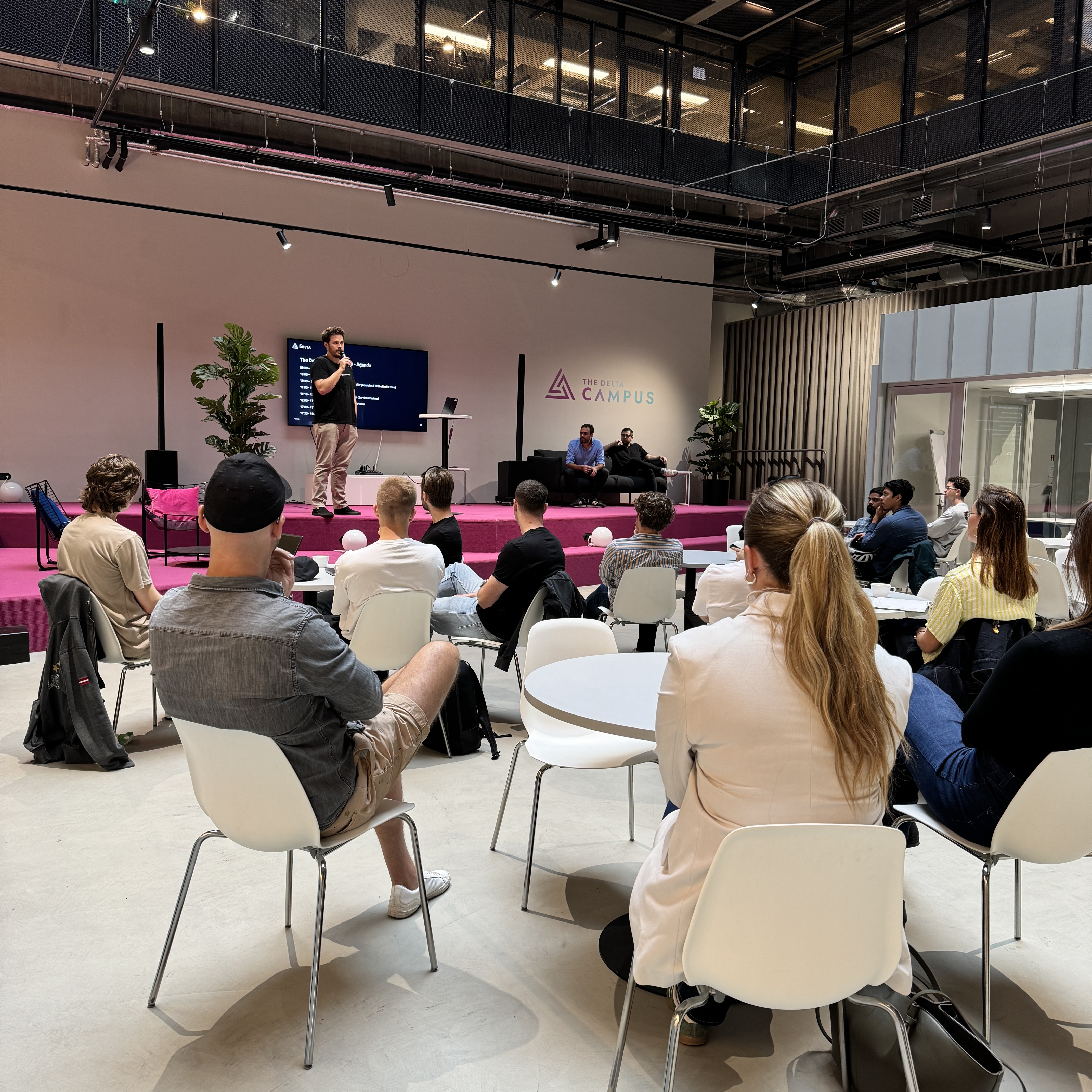
At the sixth edition of Gründerszene × The Delta, Verena Pausder did not just talk about her own companies. She talked about the one she is trying to build around everyone else's.
As Chairwoman of the Startup-Verband, co-founder of FC Victoria Berlin, and one of Germany's most active angel investors, Verena has spent the years since her Fox and Sheep exit doing something harder than founding a single company. She is trying to change the conditions that make founding possible in the first place.
This is a story about what comes after the exit, and why the work is just getting started.
The football club nobody thought would work.
In 2022, Verena and five other female founders watched the story of Angel City FC unfold in Los Angeles. Natalie Portman, Eva Longoria, and Serena Williams were backing a women's football club built from scratch, fighting its way to the first division of American soccer.
Verena had played football since she was five years old. She had always been the only girl on the pitch. Her parents hadn't pushed it as a career, so she had never considered that it could be one. But she had spent years wondering why Germany, the biggest football nation in the world, treated women's football as an afterthought.
Sitting in Berlin, she and her co-founders asked a simple question.
If not here, then where?
They approached Hertha. They approached every major club they could find. They heard no, again and again. Eventually, a 65-year-old club president at a small Berlin club called Victoria said yes to the idea of carving out a standalone women's team and turning it into something new.
FC Victoria Berlin was born.
Four years later, the club sits fifth in Germany's second division. Their annual budget is €2.5 million. Bayern Munich and Wolfsburg spend five times that on their women's teams. For most of their existence, FC Victoria ran on €10,000 supporter tickets from a small group of committed shareholders, a model that was never going to get them to the Bundesliga.
Then, in September 2024, Monarch, the largest football investment fund in the world and one founded by three women, invested in the club.
The goal is the Champions League. Not as an ambition for its own sake, but to prove something specific. That a women's team can reach the top of European football without being financially dependent on a men's club. As soon as the men struggle, the women get cut. Verena wants to show there is another way.
Germany has an innovation problem. Here is what it looks like.
As Chairwoman of the Startup-Verband, Verena works at the intersection of founders, investors, and policymakers. What she sees there is a country with enormous potential that is consistently failing to invest in its own future.
Germany has world-class universities. It produces some of the best engineers in the world. It has 450 million people across a connected European market. It is one of the most stable, liveable countries on earth.
And yet, somewhere between mid-century and now, it stopped betting on what comes next.
In the middle of the last century, Germany invested roughly 4 percent of its GDP in innovation. Today that figure is around 0.16 percent. Pension funds and insurers are sitting on billions in capital earning returns of around 1.4 percent, and almost none of it flows into venture capital. In France, 7 billion euros from insurance and pension funds entered the startup ecosystem in recent years. In Germany, that pipeline barely exists.
The structural consequence is predictable. Founders struggle to raise. Deep tech companies that need patient capital can't find it domestically. And the people who could change that have no incentive to do so.
Verena is not resigned to this. She is working on the problem.
Her approach is to bring founders and policymakers into the same room, repeatedly, in the form of sector-specific round tables. Twelve defence tech startups. Twelve AI companies. Ten space tech companies. Not lobbying for individual businesses, but showing politicians that entire industries are ready to move and need the conditions to do so.
The message she takes into those rooms is not frustration. It is a possibility.
On not letting Europe talk itself into decline
One of the sharpest moments of the evening came when Verena talked about the way Germany and Berlin discussed themselves.
She described a challenge she set with her husband. For four months, they were not allowed to say anything negative about Berlin. Only the positives. The exhibitions, the food, the energy, the parks, the creative scene. By the end, he had rediscovered why he loved the city.
Her point was not that Germany's problems aren't real. It was that the habit of leading with weakness is itself a problem.
Germany is the place people run to when things fall apart elsewhere. It has a functioning democracy at a time when that is genuinely rare. It has talent, infrastructure, and a quality of life that most of the world would choose if given the chance. The startup ecosystem has founders from dozens of countries who came here because they believed in what was possible.
Verena's argument is that Germany should start telling that story louder, starting with the people already building inside it.
What comes after the exit
Verena left Fox and Sheep on 1 January 2020. She walked into a pandemic, four children doing homeschooling, and a husband running a business that was one of the few allowed to stay open during lockdowns.
The relaxation she had planned lasted about six weeks.
But something more important happened in that period. She had the space to decide, clearly and deliberately, what she wanted to build next. Not what the market needed, not what investors were funding, but what she actually believed in.
The answer turned out to be the ecosystem itself.
Fifty angel investments, half of them in women-led companies. A football club as a proof of concept for structural change in sport. A role at the Startup-Verband pushing for the policy conditions that would make the next generation of founders more likely to succeed.
At 47, she describes herself as just getting started.
Her message to the room was direct. Don't ask when you'll be done. Don't plan the exit to a slower life. Europe needs its best builders to stay in the game, to keep founding, keep investing, and keep showing that it is possible to build something that matters here.
The work is not finished. In many ways, it is only the beginning.
Founder Learnings
The work after an exit can be more impactful than the company itself if you choose it deliberately.
Ecosystem building is a long game. The founders who shape it are the ones who stay.
Structural change in any industry, including sport, follows the same pattern as any startup. Start where others said no and prove the model works.
Germany has the ingredients. What it lacks is the belief and the capital flows to match. Both are fixable.
The best reason to keep building is not personal ambition. It is the recognition that if you stop, someone else will not pick it up.
If you want to build something that lasts and do it alongside people who are thinking the same way, The Delta Campus is where that starts, so book your tour now or contact us.
Written by Alexandra Matthews
Chief Operating Officer