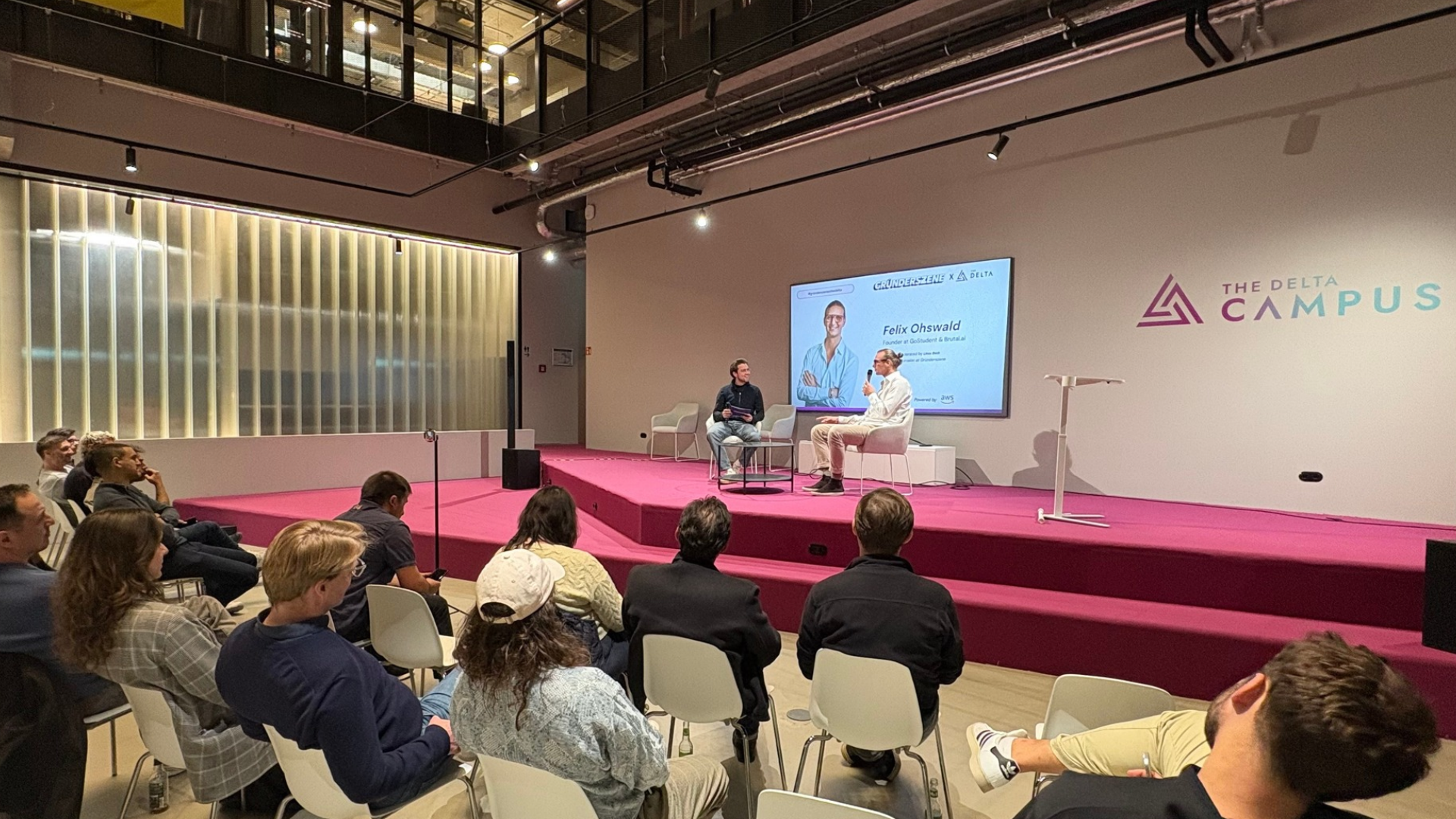
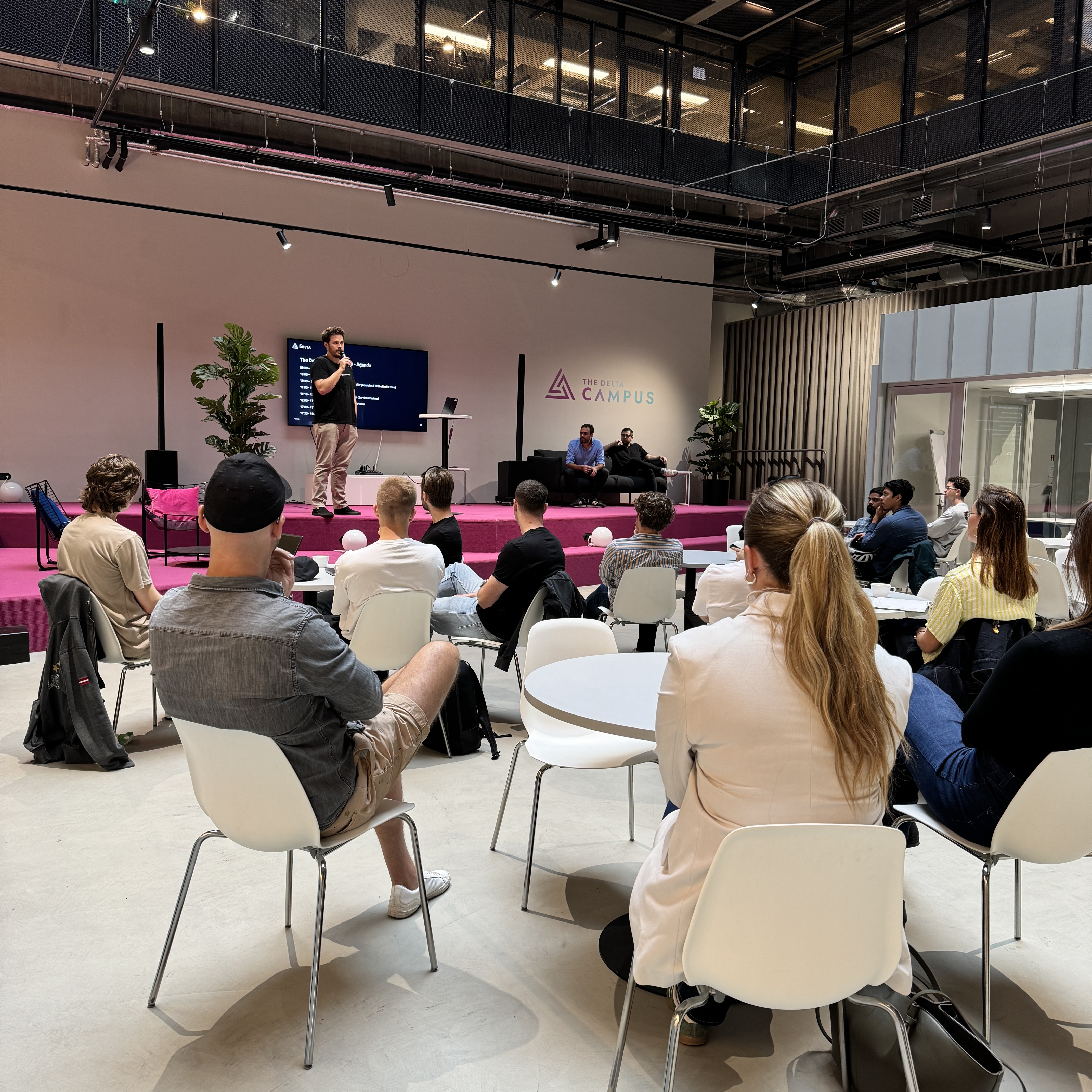
At the 11th edition of Gründerszene × The Delta, Felix Ohswald did not just talk about the rise and reset of GoStudent. In conversation with Gründerszene journalist Linus Beck, and in a lively Q&A with the audience, he talked about what came next: buying an offline tutoring business in the middle of a restructuring, spinning out an AI company from his own frustrations, and preparing to open GoStudent's first schools.
As co-founder of GoStudent, which today teaches more than 250,000 families a year in Germany alone, and now co-founder of Brutal.AI, Felix has a rare view across both education and enterprise AI. And through all of it, one thing has stayed the same.
This is a story about what drives a founder after the hardest chapter, and why solving problems matters more than any number.
Parents wanted offline, even during COVID
Even during lockdowns, when people were told to stay at home, the number one reason GoStudent could not close certain customers was that parents wanted in-person tutoring. "We were like, it's COVID outside, you have to do it online. And they said, no, no, we have to come to your place."
Felix believes in-person support helps especially for kids aged five to twelve or thirteen, for whom motivating yourself in front of a computer is hard. So in 2022, while the company was letting people go, the founders faced a choice: build their own tutoring centres from scratch, or buy a company that already had the infrastructure.
They chose to buy. In Germany, two tutoring brands are household names, both founded in 1974, both with around a thousand locations, and both owned by private equity at the time. GoStudent acquired Studienkreis. Convincing their tech investors to back a physical retail business was not easy. "They want to see tech businesses. But we said, it's the right thing to do for the company."
Online DNA in an offline business
Asked whether online or offline is the future, Felix's answer was both. It comes down to personal preference. Online, GoStudent teaches one-to-one. Offline, it teaches small groups, because that experience works better in person.
He also believes local communities will matter more, not less, as people spend more time on their phones. And what makes GoStudent different is that its DNA is still online. "We bought an offline business, but we bring this DNA into the offline business." That mindset, he said, lets them expand far faster than traditional offline players.
Why Brutal.AI exists
After restructuring and a series of six acquisitions, GoStudent grew into a group with more and more people, and Felix ran into something he hates: organisations where nobody feels accountable.
His example was deliberately ordinary. Ask your head of finance for the monthly numbers on the first working day instead of the seventh. To deliver, that person needs a data person, maybe a product person who writes a ticket, and an engineer. "As soon as you have this dependency of more than two people, things start to slow down and become very political. And I hate that. I really hate it."
So Felix and his co-founder Gregor hired what they called brutal engineers, brutal in the sense of a brutally new approach. They sat right next to the founders, with no one else from the organisation involved.
The first problem was data. With five companies, each with its own CRM, back end, and ad accounts, there was no single view of the business. The engineers built a central data warehouse, with the data described clearly enough for AI agents to use. "All of a sudden, I have an AI agent that knows all the numbers about my business."
The second problem was the website, where a single change needed four or five people. They migrated it to a modern Next.js framework, so people across the organisation can now make changes directly in a sandbox environment.
Then other companies started asking for brutal engineers of their own. So the founders spun it out as a separate company, with GoStudent as the main shareholder. Today, Felix splits his time fluidly between the two, applying what Brutal.AI learns inside GoStudent and showing other companies what worked.
Asked by a student in the audience how Brutal.AI stands out when so many companies are building their own agentic AI systems, Felix pointed to the one thing competitors cannot copy: they are operators themselves. Many AI service providers have great teams, he said, but struggle to translate what they do into something a business recognises. Brutal.AI's pitch is simple and concrete: "This is the problem we experienced at GoStudent. That's how we solved it. That's the impact. Do you give us a chance?"
His message for early-stage founders was clear: "If you today need to rely on another person to make changes on your web platform, I tell you, you're doing something wrong."
Sell by letting people experience it first
Much of the Q&A came back to the same theme: how to find customers. Felix's answer was always practical.
At GoStudent, there are two kinds of customers. Some come with an urgent problem, like a bad grade. "It's a bit like going to the doctor." GoStudent gives them a free first experience with a great teacher, and that is the perfect moment to sell. Others do not have a problem yet, so the company gives them a reason to try it, such as weekend robotics courses for families looking for something exciting to do, and upsells later.
At Brutal.AI, which mainly works with companies doing between €50 million and €2 billion in revenue, the approach is similar: do not be too pushy early, give them a taste of how it can solve their problems, then sell.
Finding a smarter way to customers
One founder asked how anyone wins a SaaS race when AI makes products easy to copy. Felix's answer: find a smart hack to reach customers, and do it yourself.
Brutal.AI partners with an executive search firm, because headhunters already have deep trust with company leadership. The partner receives 20% of Brutal.AI's service fee for the first 18 months, and can convert that into equity if they prefer. "If you sell enterprise software to companies, it's still very personal."
He also practises what he preaches. GoStudent is currently looking to acquire state-recognised private schools in Germany, and Felix set up a Claude routine that reaches out every day with personal emails to the people who run them. Then he does the calls himself. "I do the full funnel, basically. Don't shy away from getting your hands dirty."
Personal beats perfect
Asked about service quality, Felix said it comes second. First, get in front of a customer, even if what you have is still raw. "I can debate as much as you like about the quality of a teacher, but I need to get the teacher in front of a kid first." Make them pay, observe what works and what doesn't, then iterate quickly.
When a bootstrapped Berlin founder asked for advice on finding customers in Germany and Europe, his answer was to reach out, but personally. Almost everyone has a social media profile or an email address you can find. Pick a small group of people and send them something thoughtful. Generic messages, he said, get ignored, including by him. "If you send me something that is thoughtful, there's a 99% chance I will answer."
He also encouraged founders to look beyond pure digital markets. He shared how, out of curiosity about why his custom shirts cost so much, he spent a weekend experimenting with creating digital clothing patterns. A chemist friend showed him how far behind his industry is in using AI, from replicating recipes to reformulating products for new regulations. "Those are industries that solve real-world problems, and they are very, very under-digitised."
Why kids still need people
On whether AI tutors will replace human ones, Felix pointed to a concerning trend. Across every country GoStudent operates in, kids' basic skills in reading, writing, and maths are declining significantly. Without those basics, children are excluded from most social activities and future careers. "For a person that is not able to read and write properly, it's an illusion to think that person is now using the phone and an AI tutor to practise that."
So GoStudent believes the social, local, motivational element will stay essential, even if, as he put it, "maybe it's a robot in the future that teaches the kid." Instead of seeing a decline, the company sees the opposite: before COVID, 7% of its students were in primary school. Today, it is 25%.
One founder in the audience asked how GoStudent keeps parents and teachers from simply going around the platform after a trial. The honest answer: around 80% of teachers just want to teach, not acquire customers or chase payments. In the managed part of the online business, teachers split their fee 50/50 with GoStudent in return for all of that. In the open marketplace, they can set any price they want, but handle everything themselves. As Felix put it, as soon as you run your first online ad, you're happy to only give up 50%.
Opening schools, and the answer that stayed with the room
Asked which European education system he admires, Felix said the differences in what kids learn are small: it always starts with reading, writing, and maths. The real difference is operational: how teachers are trained, supported, and kept happy. A public school in Berlin receives around €10,000 per child per year, so a school with a thousand kids is effectively a €10 million business. Running that well is what matters, and it is exactly the focus at GoStudent's centres: a great centre manager, great teachers, and a strong community.
That focus is about to go further. After ten years of after-school services, GoStudent is opening its first schools in 2027.
When Linus asked where Felix sees himself in ten years, he did not talk about the number of tutoring centres or valuations. "I hope I can still have this situation where I wake up in the morning and I can solve certain challenges. That's what I love doing."
It was the moment that stood out most in the closing remarks, too. The host, who had been in a similar situation himself, admitted he would have answered with the vision and the numbers. He also paid respect to the discipline it took to make such a drastic cut only months after raising €200 million. But it was Felix's humble, precise answer that stayed with the room. What we want to do every day, the thing that gives us energy, is where we are at our very best, and it is an underestimated part of thinking about vision.
Founder Learnings
- Listen to what the market keeps asking for. GoStudent's move into offline came from parents demanding in-person tutoring, even in the middle of COVID.
- Bring your DNA into whatever you buy. An acquisition grows faster when you bring a different mindset into it.
- Remove dependencies, especially early. If you need other people to change your own product, take back control, with AI if you need to.
- Let customers experience it before you sell. A free first session or a taste of the solution does more than a hard pitch.
- Personal beats generic, every time. Small groups of thoughtful, personalised messages get answers; templates get ignored.
- Get in front of customers before it's perfect. Make them pay, observe, and iterate quickly.
- Look where the competition is not. Under-digitised real-world industries are full of problems worth solving.
- Define success by what you love doing. Felix's vision is not a number, but waking up every day to solve a new challenge.
If you want to build something that lasts and do it alongside people who are thinking the same way, The Delta Campus is where that starts, so book your tour now or contact us.
Written by Alexandra Matthews
Chief Operating Officer