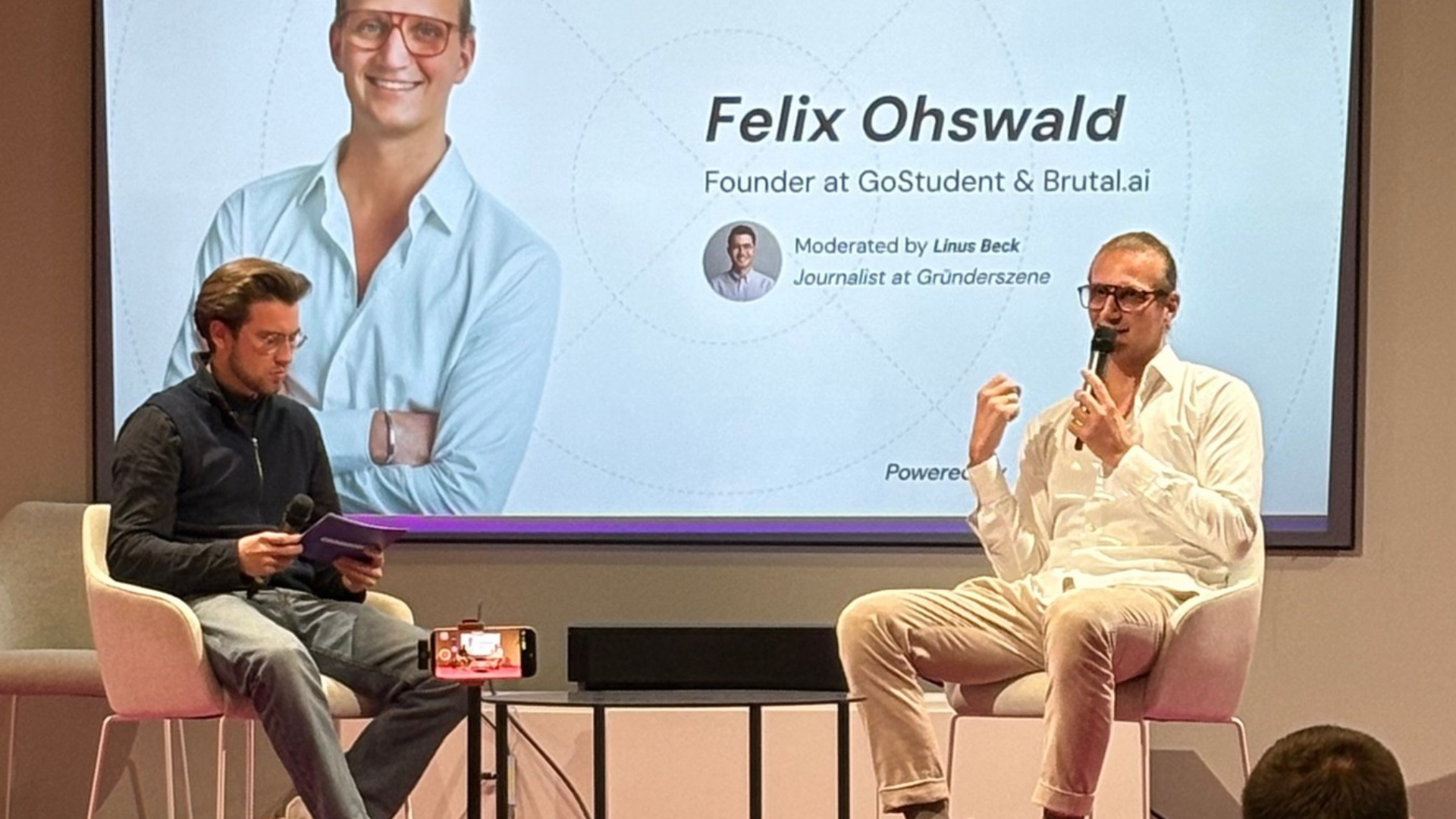
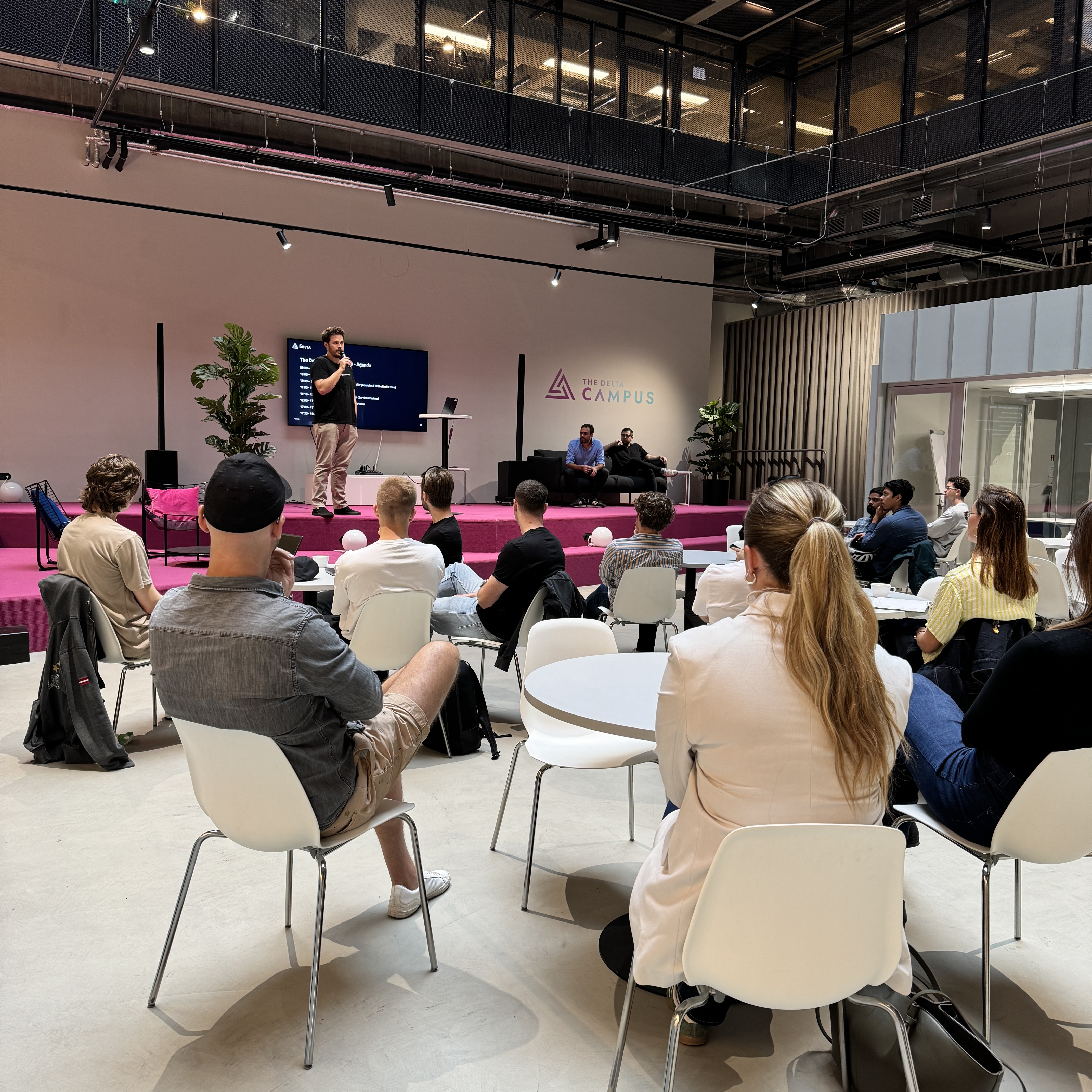
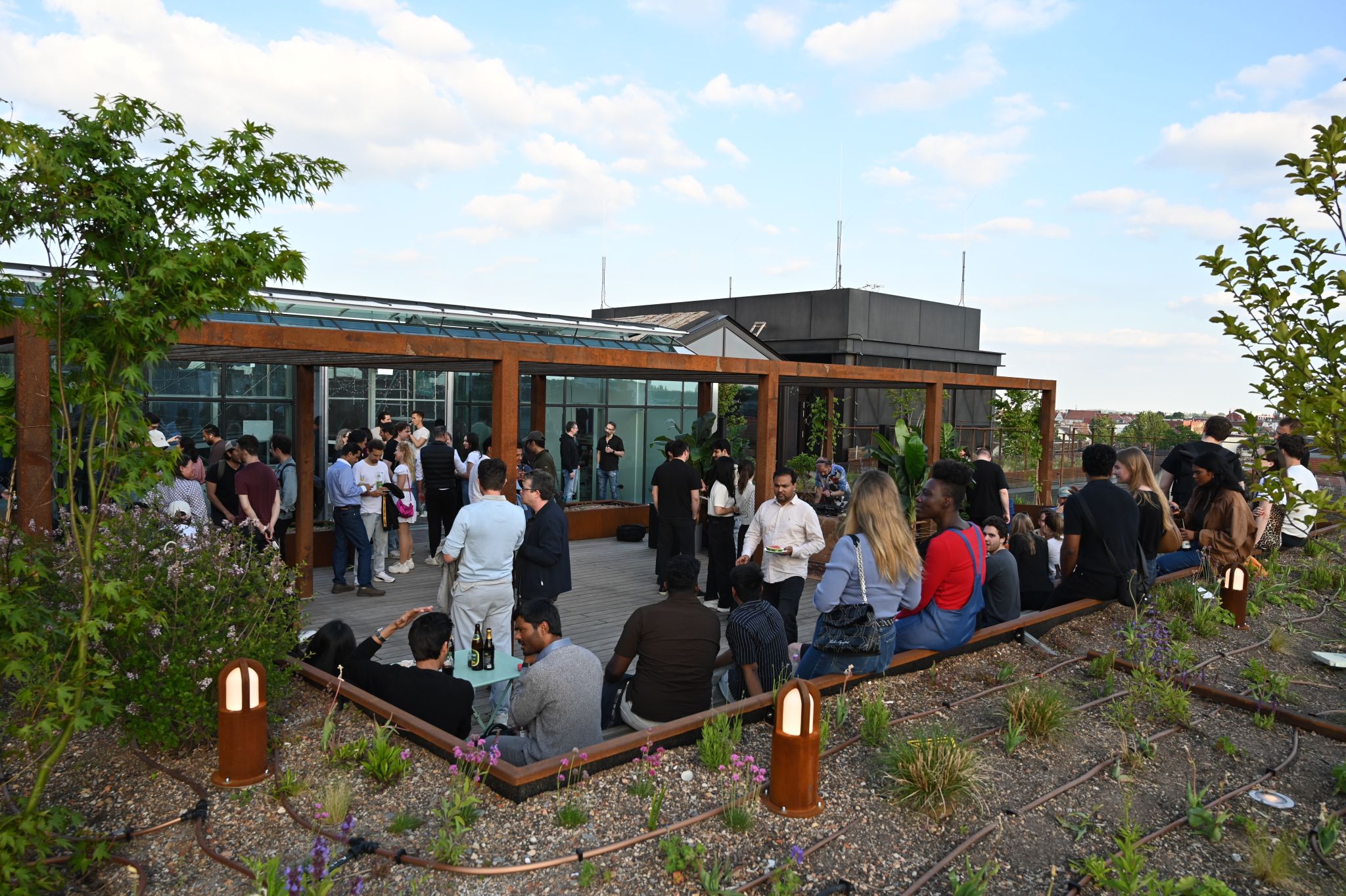
At the 11th edition of Gründerszene × The Delta, Felix Ohswald joined Gründerszene journalist Linus Beck on stage in front of a packed room of founders, operators, and investors for one of the most candid conversations we have hosted in this series.
Felix co-founded GoStudent, which connects school students with tutors for personalised one-to-one lessons, and grew it into one of Europe's best-known edtech companies. He has lived through both sides of that story: the rapid rise, and the hard decisions that followed. Today, alongside GoStudent, he is also building Brutal.AI.
But the story he told started long before any of that, with a five-year-old and his grandfather's computer.
A kid who lived online
Felix was first exposed to a computer at five, a big old machine at his grandfather's home. "Ever since I was five years old, I probably spent more time on the computer and online than offline," he said. Between the ages of five and twelve, he was deep in the online world, and he admits he took some bad turns. He spent much of his time on onion sites and in online forums on the darknet, and by the time he was 11 or 12, he was making five figures a month.
Then his parents found out. His dad's reaction was simple: you clearly have no problems at school, and you spend all your free time on this. Do something useful. He took the computer away.
Felix had always loved mathematics, so he asked himself what the next best thing to do after school was. The answer: go to university.
Studying maths at 14, without skipping a class
At 14, Felix started studying mathematics at the University of Vienna. He never skipped a grade at school, because he believed it was important to be with people his own age. Instead, while other kids went to sports practice in the afternoon, he went to university lectures. "I was bored, basically, at the end of the day. I wanted to have some challenges."
Nobody at university noticed his age. He had already finished growing at 14 or 15 and was over two metres tall. Languages were the one subject he never enjoyed: his mother tutored him in Italian, and he hated it.
Studying early became a door opener. It introduced him to interesting professors and people, and it led to a recommendation to study at Cambridge, and later at ETH Zurich. Looking back, it also shaped how he thinks about education today. He never understood why more kids with a clear interest, whether history, philosophy, or engineering, did not get the chance to follow it alongside school. "Don't put a kid that has an interest in engineering in an art class that the kid does not enjoy."
The first user was his brother
The idea for GoStudent came from his brother, five years younger. When Felix was around 20 and finishing his studies, he noticed that everyone in his brother's class used WhatsApp, and his brother was always texting him for help. Messengers were taking off, so the idea felt obvious: connect kids with great teachers in a chat.
His brother became the first user, then shared the number with friends. Very quickly, over a thousand kids were using the WhatsApp number, without a cent spent on advertising.
Looking back, Felix thinks one decision was a mistake: the team became so fixated on having their own platform instead of continuing with WhatsApp that they raised money from a business angel to build it. There was no business model yet. The goal was simply to grow a community of online students as fast as possible.
It was never about the business case at first. "When you get annoyed by something, when you see a certain problem, you just want to solve it." He compared it to marathon training, which he admits he hates: you have to fight your inner demons every day to get there. "I challenge myself, and I do it until I succeed."
300,000 users, and no way to make money
After one to two years, GoStudent had a community of 200,000 to 300,000 students using its homework Q&A platform regularly. The team tried everything to monetise it: a paywall, subscriptions, pay-as-you-go, charging parents. Nothing worked. After about a year and a half, they accepted that the model was not sustainable.
So they stepped back and asked what families in their community actually spend money on regularly. For children aged six to eighteen, there are really only two things: school fees and tutoring. They did not have a school, so the answer was clear. It was 2018 and 2019, and Zoom had just made video calls possible on most household devices. "Everyone here knows Skype, but from a customer experience it was not good. With Zoom, it changed."
The team built proper online tutoring sessions and showed them to their community, convinced they were about to become the biggest tutoring company in the world. What happened? "Nothing. Nobody cared."
Picking up the phone
What happened next is, in Felix's view, one of the main reasons GoStudent became more successful than every other online tutoring company: they called the parents. They literally phoned families and asked why nobody was using their carefully selected teachers. The answer surprised them. Nobody understood what online tutoring was. It was still before COVID, and parents thought they were being sold something like a YouTube video.
So the team got creative. On Kleinanzeigen, Germany's biggest classifieds marketplace, you can find in-person tutors in every small village. GoStudent wrote a script that uploaded teacher profiles in every city in Germany. When a parent reached out to "a teacher in Münster", the sales team called them and explained that everyone was now doing it online, and that it was more effective. Felix admits it was not exactly allowed, and that the platform has become much better at catching this kind of thing since.
It worked. They had found a cheap, effective way to generate leads for trial sessions, and a team of real people did the rest: one call to book a trial, a second call afterwards to sell a long-term membership. With memberships worth €1,000 to €2,000 over around 18 months, at a 50 to 60% gross margin, there was room to invest heavily in salespeople. "A lot of the digital platforms that started the same thing were always too afraid, or maybe too arrogant, to call people and use humans to sell it."
He added that parents are an extremely demanding audience, something he now sees first-hand as a father of three. But that pressure is a good thing. "In order to succeed, you have to build a good service and a good product."
What COVID really did
Everyone assumes COVID was a gift for an online tutoring company. The reality was more complicated. In March, April, and May 2020, normally peak season before summer exams, search volume for tutoring dropped by 30 to 40%. Schools were closed, exams were skipped or simplified, and the pressure disappeared.
But two other things happened at the same time. Everybody got used to Zoom, Google Meet, and Teams, and offline competition was swept away. So even in a shrinking market, GoStudent captured significant market share.
Hiring also became easier. Before COVID even hit, GoStudent had signed an €8 million Series A with US and UK investors, raised because the business paid for customer acquisition up front while families paid over one to two years. During lockdowns, university students and people looking for extra income were sitting at home, which made recruiting teachers cheap. Some of the best salespeople came from hospitality, which was shut down.
Felix and his co-founder stayed in Vienna throughout. He loves the city, the Austrian attitude, and the steady flow of talented Austrians who had left for Berlin, London, or Paris and wanted to come back to work somewhere fast-growing.
Indestructible, until breakfast in London
Until that point, Felix said, he had never really been exposed to failure. Everyone always tapped him on the shoulder and told him how fast and how good he was. Between 2020 and 2022, GoStudent raised more than €600 to €700 million from investors around the world, and the founders were featured as the superstars of a new generation. "You feel that you are indestructible."
By 2022, the online business alone had almost 2,500 employees, not counting teachers, across 24 markets. Then the market changed. Interest rates rose, COVID ended, and offline competitors came back. The unit economics no longer worked, and the company was burning €15 to €20 million a month.
Around April or May 2022, Felix flew to London to meet a board member for breakfast, just a few months after closing a €200 million round. The advice he got was blunt: rebuild the company. Let almost everyone go and restart. "It was a really, really solid punch to the face," Felix said. In the moment, he was ready to fight it out. But he came to see why it mattered. "Everybody around you always tells you the great things, but nobody tells you the brutal reality." Founders, he said, have to be convincing personalities, and that is exactly why it sometimes takes a hard punch to ground you.
Cutting 90%
GoStudent first let go of 70% of its staff. It was not enough. In the end, the company cut around 90% of its headcount. From roughly 2,500 people, the core team today is around 150.
Felix's way of making sense of it was to treat it as a problem to solve. "Every company in the world has one thing in common: a P&L." And GoStudent's did not look good. So you go through the cost lines. Too much spent on people: reduce headcount. Marketing too expensive in some markets: leave those markets. As emotional as it is, he said, it is solvable, as long as the underlying business has value. And helping kids connect with great teachers was always a large and growing market.
On how to handle layoffs, he was honest that it is something you only learn by doing. The first time, you are nervous, and there is a human being opposite you who believed in your company. Today, he said, they handle it far more professionally than they did back then.
The lesson that stayed
Felix compared the period to a relationship: you grow through the down periods, and you find out who sticks with you and shares the same inner drive.
But his biggest takeaway was about self-reflection. He has seen many managers over the past ten years who are convinced their way is the only way, while AI is changing entire industries around them. "You have to question yourself. Is this the best way? There's a lot of things we do completely wrong, but you have to try to learn and make it better."
Founder Learnings
- Your first users are closer than you think. GoStudent's first user was Felix's brother, and the next thousand came through word of mouth on a single WhatsApp number.
- A big community is not a business. When 300,000 users would not pay, the team went back to what families already spend money on, and built that.
- Pick up the phone. When a launch gets no reaction, call your customers and ask why. GoStudent learned that parents did not even understand what online tutoring was.
- Do not be too proud to sell with people. Human sales calls became GoStudent's edge in a market where competitors relied only on digital funnels.
- Look for honest voices, not applause. The most valuable advice Felix received was the one he least wanted to hear.
- Treat a crisis like a P&L problem. Go through the cost lines one by one, as long as the underlying business is worth saving.
- Keep questioning how you work. Self-reflection and admitting mistakes matter more than ever as AI changes every industry.
If you are ready to start building, The Delta Campus is where that journey begins, so book your tour now or contact us.
Written by Alexandra Matthews
Chief Operating Officer