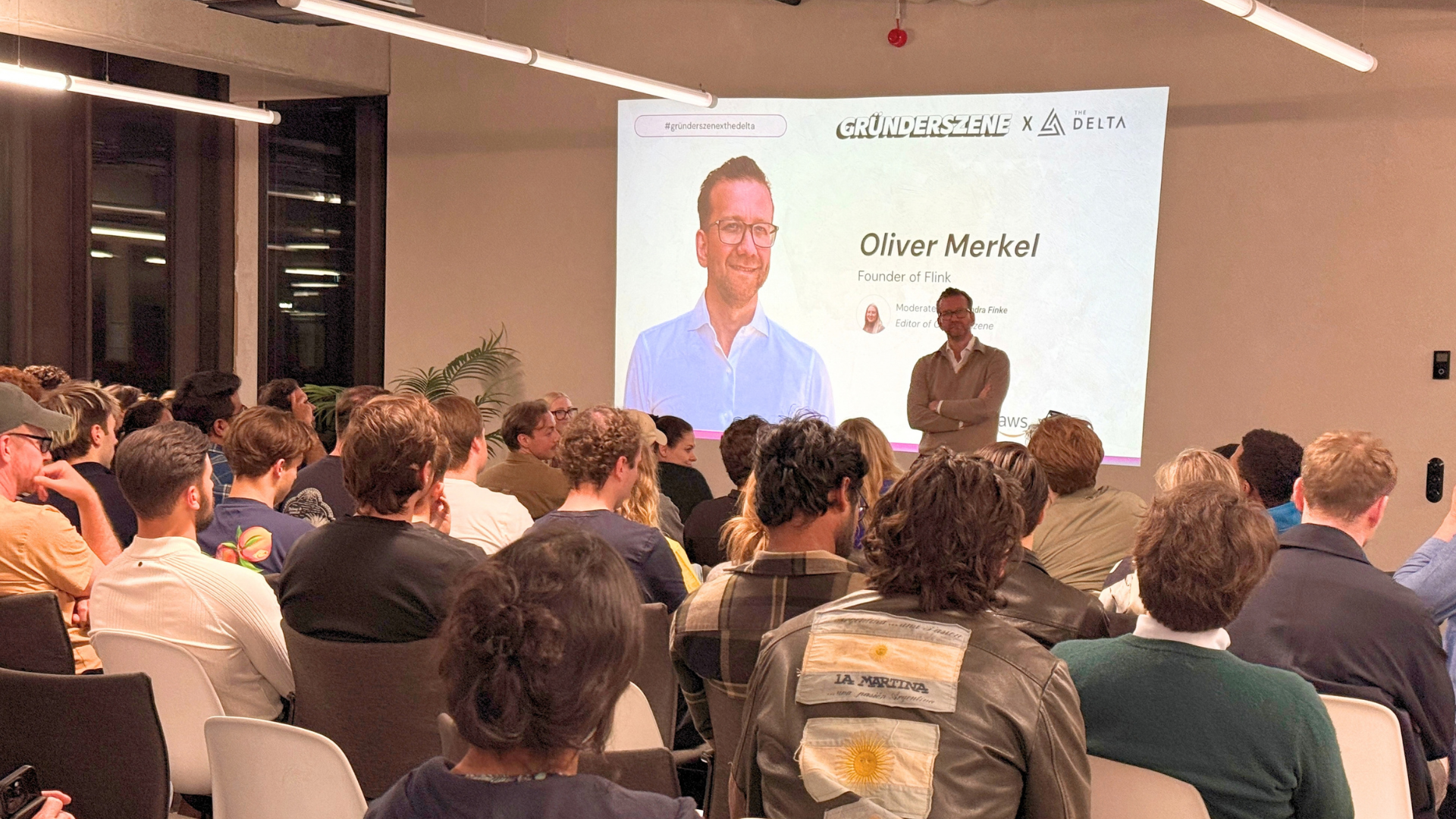
At the 10th edition of Gründerszene × The Delta, Oliver Merkel joined Gründerszene editor Leandra Finke on stage in front of around 200 founders, operators, and investors for a conversation about what it takes to go from advising boardrooms to making the calls yourself, and to survive the storm that follows.
As a former partner at BCG and Bain, the accidental co-founder of Flaconi, and the co-founder and former CEO of quick-commerce company Flink, Oliver is one of the most outspoken operators in the Berlin ecosystem. And he clearly hasn't had enough of starting businesses yet: he has already launched his next company, Blocks.
But as he reminded the audience, it all started with a 23-year-old who already knew that trading time for money was not a concept he wanted to live with forever.
A consulting career built on a simple rule
Oliver started his career at the Boston Consulting Group at 23, and later worked at Bain. He chose consulting over investment banking after doing what he still does before every big decision: collecting data. He called a few people who had started a couple of years ahead of him. The banker told him, with some pride, that Sundays were "almost always free." Oliver wasn't sure he wanted that to be the standard for his life from day one.
What consulting gave him, he says, was an education in how work actually works. "Even if you're good at university, no one actually teaches you what work is really about," he said. You learn to read a business, structure your thoughts, build a proper presentation, and spot the flaw in a business plan immediately. He still recommends it to young people, partly for the travel, and partly because at 23 you sit across from CEOs on problems they genuinely can't solve themselves. "It's like solving puzzles. That's what I always liked to do."
The frustration of never calling the shots
The problem was that, even as a senior partner, he was never the one making the decision. "You put in a lot of work hours, a lot of blood, sweat and tears, and in the end, it's not your decision," he said. He wanted to move from being responsible for no errors in a valuation model to being responsible for the actual question: should we buy this business, yes or no? "Take the full responsibility and live with the consequences."
Becoming a co-founder by accident
His first taste of building came in 2010, almost by chance. A friend called about a very smart intern who wanted to start a company. After a few weekends of brainstorming, they decided to take the perfumery business online. When it was time to make it official, Oliver was the only one who knew a notary who could see them the same day. Dirk Graber of Mister Spex was there too, and the notary pointed out that since it was Oliver's money, he needed to sign as well.
That is how he became a co-founder of Flaconi, today a leading online perfumery doing, in his words, half a billion in revenue. He is careful to give the credit to the operational founders, but those first few weeks close to the business stuck with him. "I liked it a lot, and since then I've been looking for an idea that I could take on."
Three conditions before Flink could exist
That idea turned out to be quick commerce. In 2020, supermarket orders delivered in minutes were the hottest category in tech, and Oliver spent months talking to retailers, customers, and founders. His conclusion: the way everyone else was doing it couldn't work. "They said, no, no, but we have so many millions from investors. That's the first mistake. Raising money is not success. Success is when customers buy and you make money."
So he defined three conditions. First, buying prices on par with the big retailers, because in a market as concentrated as German food retail, there is no margin without them. He secured a contract with REWE before Flink even started. Second, inbound logistics: rather than building a fleet of trucks for 170 neighborhood hubs, he convinced the retailer to simply add Flink to its existing network. "Instead of 10,000 stores, now 10,170 stores. For them, nothing changed." Third, a more senior team than the competition. When he pitched the plan to an investor he knew, the response was simple: if you know everything, why don't you do it? "I said, okay, then give me the money. And the next day he literally wired 10 million."
Riding the bikes himself
Oliver never doubted the model, and he has a simple reason why. In the early days, he did many of the deliveries himself, to understand who was ordering and what they thought. He had heard every objection: no one needs groceries in ten minutes, no one wants this. The customers told a different story. "First delivery, ten minutes, they said this is magic. Second time, this is really magic. Third time, you're 30 seconds late and it's, oh, today you're late." A new standard had been set.
Today, Flink averages around 22 minutes, and Oliver is candid that the ten-minute promise was partly marketing. "It came with momentum. But everything below 30 minutes is still very good. It's almost instant." Asked whether robots or drones could replace riders in Germany, he was sceptical: robots are capped at 10 km/h with human supervision, and drones will never get clearance over dense cities. He doesn't expect automated picking in the next five years.
A rival that got him up in the morning
Flink's main rival was Gorillas, and Oliver describes the competition as fuel. "If you are on the running track alone, you're not running as fast as if you have somebody you fight against." He still rates Gorillas founder Kağan Sümer highly, and has even invested in his new venture. His takeaway: companies can fight like crazy while the people running them still talk.
He also didn't hold back on what the funding frenzy did to the category. Getir and Gorillas together, he said, spent more than a billion euros on marketing in Germany alone. One investor shouted at him: "I wired you 200 million. You need to spend it so I can wire you more." Oliver's answer was that maybe they should spend it on things that made sense.
Growth and profitability, not growth or profitability
When his team asked whether he wanted Flink to grow fast or become profitable, his answer was always the same: both. Flink was profitable in Berlin after its first year, which proved the concept worked. The challenge was fending off competitors while still delivering the numbers. So the team tracked profitability before marketing, separated cities with heavy competition from cities without it, and kept a weekly roster of every one of its first hundred-plus stores, with a clear line showing each one's path to profitability. "With every order more, it becomes more profitable."
The same logic applied to trade-offs between teams, like price versus margin: "It's not either or, it's both, but in a balanced way." He doesn't believe in setting teams against each other on the same problem either. Agree on the hypothesis first, from first principles, and then build, instead of "people running for ages and coming back after three months to hear, oh, but this is not what I wanted."
Hypergrowth, from the inside
Running Flink at full speed meant pressure from every direction: investors who wanted returns on hundreds of millions, politicians annoyed by rider bikes on the pavement, and around 10,000 riders on proper employment contracts, with everything that comes with managing that many people. His answer was to stay calm, because "your team sees it in your eyes," and to move fast. "If out of ten decisions, six are right, the world's a happy place." Every eight to twelve weeks, the leadership went away to a hotel for three days to set strategy for the next quarter. "You cannot do a five-year plan in the startup world."
Keeping speed as the company grew meant going straight to the problem, not through the org chart, but only for problems big enough to deserve it. It also meant accepting mistakes. Flink ran a no-blame culture with a simple rule: "We always attack the problem, not the person." When something went wrong, the lesson was shared on Slack so no one repeated it.
For the riders, he described two cultures under one roof, much like McDonald's: merit-based at headquarters, where the best idea wins, and precise execution of a central recipe in the field. Keeping riders motivated comes down to the basics: pay well, pay on time, pass on tips without deductions, and react quickly to feedback, with a 30-person task force dedicated to riders alone. "If you do that, you're already 80% there."
He was also one of Flink's heaviest users. His house outside Berlin sat in a small delivery circle drawn specifically so he could test the service, which led to one of the evening's best stories: one Saturday a rider stopped outside his house with an order that wasn't his. The neighbours had worked out that his address was inside the radius and were quietly ordering everything there.
When Flink hit unicorn status after about seven months, there was no party. Just a short Slack message and back to work. "If you train for a marathon and finish under four hours, you can celebrate," he said. A unicorn valuation, by contrast, was about being in the right place at the right time with the right model, while investors were throwing money at the category. "I don't think it's a goal per se to become a unicorn. I think it's just build a good business."
The week before Christmas
The hardest moment came when an investor pulled out of a financing round at the last minute, despite a signed term sheet, a week before Christmas. Oliver ran two workstreams in parallel: negotiating a merger with a competitor he didn't want, while pitching new investors and securing bridge financing from existing ones. In the end, a new investor came in with 50 million.
His advice for leaders in that position was specific. Start a paper trail with lawyers and tax advisors the moment you see a theoretical risk. And don't push the pressure onto your team. "It's not their job. They cannot influence it. You just make their lives miserable. You take responsibility for it."
Oliver and his co-founder later left Flink after a disagreement with part of the investor base over selling the business. Today, he says, Flink is cash flow positive, still growing, and profitable.
Founder Learnings
- Collect data before every big decision. Oliver chose his first employer by calling the people a few years ahead of him and listening closely to what they considered normal.
- Funding is not validation. A term sheet proves an investor believes you; only paying customers and a real margin prove the business works.
- Define the conditions for success before you start. Flink's buying prices, logistics partnership, and senior team were all in place before the first order.
- Get close to the customer yourself. Doing deliveries in person gave Oliver a conviction no naysayer could shake.
- Growth and profitability aren't a choice. Track each unit's path to profit, separate what competition costs you, and push for both.
- Speed beats perfection. Most decisions are reversible, so make them with the data you have, attack the problem rather than the person, and correct course when you're wrong.
- In a crisis, absorb the pressure yourself. Your team can't fix a financing gap, so shielding them from it is part of the job.
If you are ready to start building, The Delta Campus is where that journey begins, so book your tour now or contact us.
Written by Alexandra Matthews
Chief Operating Officer