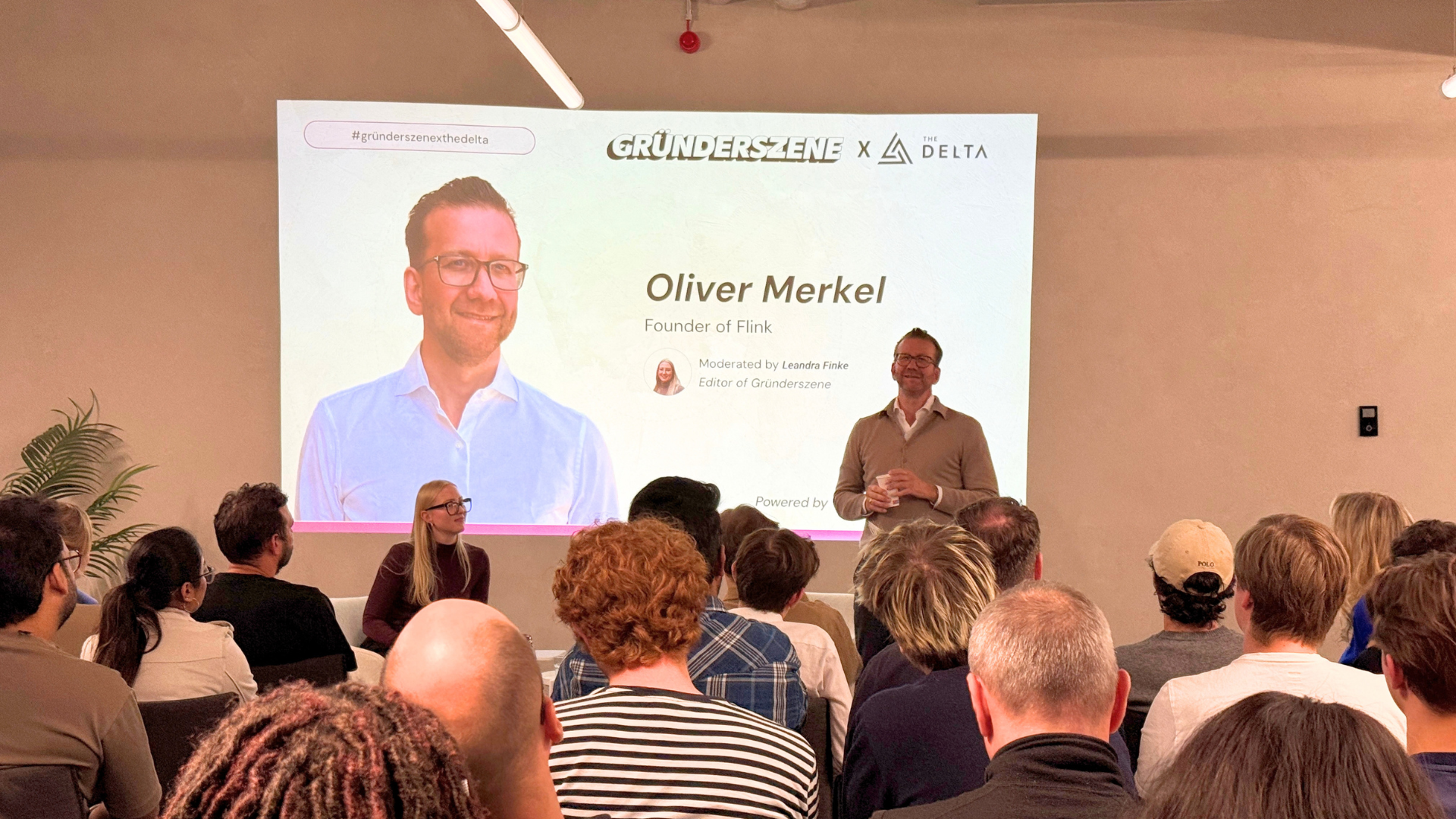
At the 10th edition of Gründerszene × The Delta, Oliver Merkel did not just talk about Flink. In conversation with Gründerszene editor Leandra Finke, and in a long and lively Q&A with the audience, he talked about the 60 to 70 startups he has backed as an angel investor, the rules he uses to raise money and build teams, and the problem that became his next company.
As co-founder of Flink, an investor with a handful of unicorns in his portfolio, and now founder of the AI cloud-control company Blocks, Oliver has spent the time since leaving Flink doing something harder than resting on one success. He is starting again from zero, in a completely different market, and moving fast.
This is a story about what comes after the exit, and why the best ideas often come from the problem that annoyed you most.
Investing as a weekend hobby
Oliver describes angel investing as "a little side hobby" he does on weekends. What draws him in is the conviction of founders willing to bet the next five years of their lives on an idea. "I applaud you if you're now starting a company," he told the room.
His criteria are simple: a big, growing market that can be disrupted, and above all, the team. Quoting Mike Tyson, "everybody's got a plan until they get hit in the face," he explained why resilience matters more than the plan itself. "If the first no comes out of the 3,000 to come and the team already falls apart, that's not going to work." Co-founders help here too, he said, because shared pain is only half the pain.
He has no strong view on solo founders, as long as they build a strong team to think out loud with, "otherwise you go crazy." And yes, he is still open to a 61st investment. He makes three to five a year and promised the room honest feedback on any idea sent his way.
The best bet, and the one that got away
His best-performing investment was his very first: a 2010 startup, since acquired by Snap, that tried to solve fashion e-commerce returns by scanning body measurements through a laptop camera, using a CD as a size reference. It won startup of the year, the chancellor visited, and revenue was close to zero. The flaws were obvious in hindsight: few shoppers wanted to stand half-naked in front of a webcam, and fit is a personal preference, not just a measurement.
So the team pivoted, using a million data sets to tell shoppers how a size at one brand compared to another. They quietly onboarded around 150 retail customers and, eleven years later, sold for roughly a hundred million euros in cash, never having raised again after a first round at a €1 million valuation. "Ignore the press. Ignore what people tell you about how great you are. If the customers love it and are paying for it, that's what matters."
The one he regrets is Parloa, the Berlin voice-AI unicorn. At seed, he assumed every standard LLM would soon handle voice. What he missed was that the magic happens in the background: connecting to the legacy systems of a company like Lufthansa, without which even the best model can't find your booking.
How to raise money, according to Oliver
Oliver's fundraising advice started with asking people who have done it before. Then he writes memos, not decks. "It forces you to write down your thoughts in a clear and structured way," he said, and it gives you a built-in self-correction: write it, get a coffee, reread it, and you'll know if it holds up.
He compares fundraising to dating. If a VC is genuinely interested, they'll find time tonight and put down a term sheet quickly. If they aren't, you'll hear that you're great but the timing isn't right. Echoing what Julian Teicke, one of the evening's hosts, had told the room earlier, he said to expect nine out of ten to say no, not to take it personally, and to treat it as a funnel. Practise your story before you call the investor you most want on your cap table. And one rule he picked up in consulting: whatever amount you think you need, double it. "No VC is ever so much in the detail that they will say, I only give you 4.8 and not the five you're asking for."
Asked whether founders should share their doubts in a pitch, his answer was no. "If you don't believe in it, how should I believe in it?" Think the idea through beforehand, then leave the doubts out of the room and pitch with full conviction.
He was just as clear that VC money is a means to an end. At Flink, with competitors raising billions, raising big was unavoidable. But money can also lead to bad decisions. His test: if you know exactly how more capital will help you build something much bigger, faster, take it. If not, keep your equity and stay in control.
Two kinds of hires
On team building, Oliver's first rule is that choosing a co-founder is like a marriage. Picture the worst case, an insolvency, and ask how that person would react. If all signals are still green, it may be the right person. Keeping it strong is about communication and regularly stepping away: two or three days at a hotel outside Berlin, phones off. Day to day, Flink and Blocks run a Monday management meeting with a clear promise to the team: if you're stuck on a decision, you have at most four working days before it gets made for you.
Beyond that, he sorts roles into two categories. Some jobs just need a very smart, driven person with a strong work ethic, who can be let loose and will outwork everyone. Others require someone who has done it before: Flink's head of data had spent six years scaling a data team at Delivery Hero from one to a hundred people. The categories can also cross. Flink hired experienced category managers from big retailers, only to find that after a few weeks the team had learned what it needed, and drive mattered more than experience.
He was also honest about people outgrowing roles. A friend who served as Flink's first CFO was excellent in the early days, but at around 200 million in revenue the company needed someone who had done it at scale. Asked how to decide between coaching someone and replacing them, Oliver said coaching always comes first, with direct feedback and tangible steps. People are rarely wrong for the company, just in the wrong role. If objectives are missed again and again, the person usually knows it too. "Is it painful? Yes. He's still a friend. But he didn't talk to me for two months."
The cloud bill that started Blocks
Oliver believes the best business ideas solve a problem that bugs you personally. At Flink, that problem was the cloud bill. On the road to profitability, speeches and memos about cost discipline weren't landing, so he began personally signing off every invoice, down to taxi receipts. The cloud bill still rose another 50k in a month. The CFO didn't know why. The CTO didn't know why. The engineers could spin up services without any cost control.
So he sat the engineers down in a meeting room and asked them to explain, in plain English, how it all worked. By the end of a long afternoon, the whiteboard showed 18 to 19% in savings. "As the founder you know two things: there's definitely more, and there's zero oversight."
Blocks is the tool he wishes he had back then: an agentic DevOps and AI platform that acts as a control layer for cloud infrastructure, covering cost, security, and observability. Because infrastructure changes need to be right every time, it is trained on private infrastructure data, which Oliver likens to a medical GPT rather than a general-purpose chatbot. He pitched the idea to 11 investors, deciding in advance that if half said no he'd go anyway. They all said yes, and the round was oversubscribed.
The no is only for everybody else
One founder in the audience pointed out that Blocks depends on companies handing over access to their infrastructure data, and that Oliver's network makes that easier. What if you don't have that trust yet? His answer brought the evening full circle. "The no is only for the others. When somebody says no, it's for everybody else to stop. Your job is to find a way around it, jump over it, smash the wall, or find somebody who says yes."
In practice, that means earning trust in small steps. Blocks starts with read-only access, where the downside is very limited. "No one in his right mind would give you access to GitHub right away." But after the tenth fix that works, customers are ready to connect more, which is why autonomous features are the plan.
The same attitude applies to German bureaucracy. The notary process frustrates him enormously, but it should never be the reason not to start. "Start the company, complain a bit about it, and maybe something changes one day. But do your job: start businesses, build, and create jobs."
Persistence has limits, though. When a founder shared that they had dropped an idea customers didn't want, Oliver backed the call: "There's a difference between being strong and brave and being stupid."
Major Tom, pink backpacks, and the next chapter
The AI agent at the heart of Blocks is called Major Tom, a name that came from a story Oliver told his co-founder Andreas over a glass of wine about meeting David Bowie when he was 19. His branding advice: don't overthink it. Flink's famous pink, he revealed, came about because the Chinese supplier of their first thousand backpacks only had black or pink.
Blocks went live in spring, reached €1 million in ARR within its first month, and is now at a €10 million run rate after five months, with a team of around 25. It has deliberately constrained itself to AWS, Germany, and cloud-native companies, because "you need to earn the right to play." Next up: adding Google Cloud, launching in the US by the end of the year, and building an AI inference optimisation layer. His hope for a year from now is a successful US launch and the inference layer live.
Founder Learnings
- Build what bugs you. Blocks came directly from Oliver's own frustration with a cloud bill nobody at Flink could explain.
- Customers are the only validation that counts. His best investment won awards and press with no revenue, and only became a business after a pivot to something people would pay for.
- Treat fundraising as a funnel, not a verdict. Expect nine out of ten investors to say no, pitch with full conviction, and ask for double what you think you need, but only raise when you know exactly what the money is for.
- A no is a wall to get around, not a stop sign. Earn trust in small, low-risk steps until the yes becomes easy.
- Hire for the job, not the CV, and coach before you replace. Most people who struggle are in the wrong role, not the wrong company.
- Know the difference between brave and stubborn. Walking away from an idea the market doesn't want isn't giving up on being a founder.
- Constrain first, expand later. Blocks is earning the right to play in one cloud, one country, and one customer type before scaling to more.
If you want to build something that lasts and do it alongside people who are thinking the same way, The Delta Campus is where that starts, so book your tour now or contact us.
Written by Alexandra Matthews
Chief Operating Officer