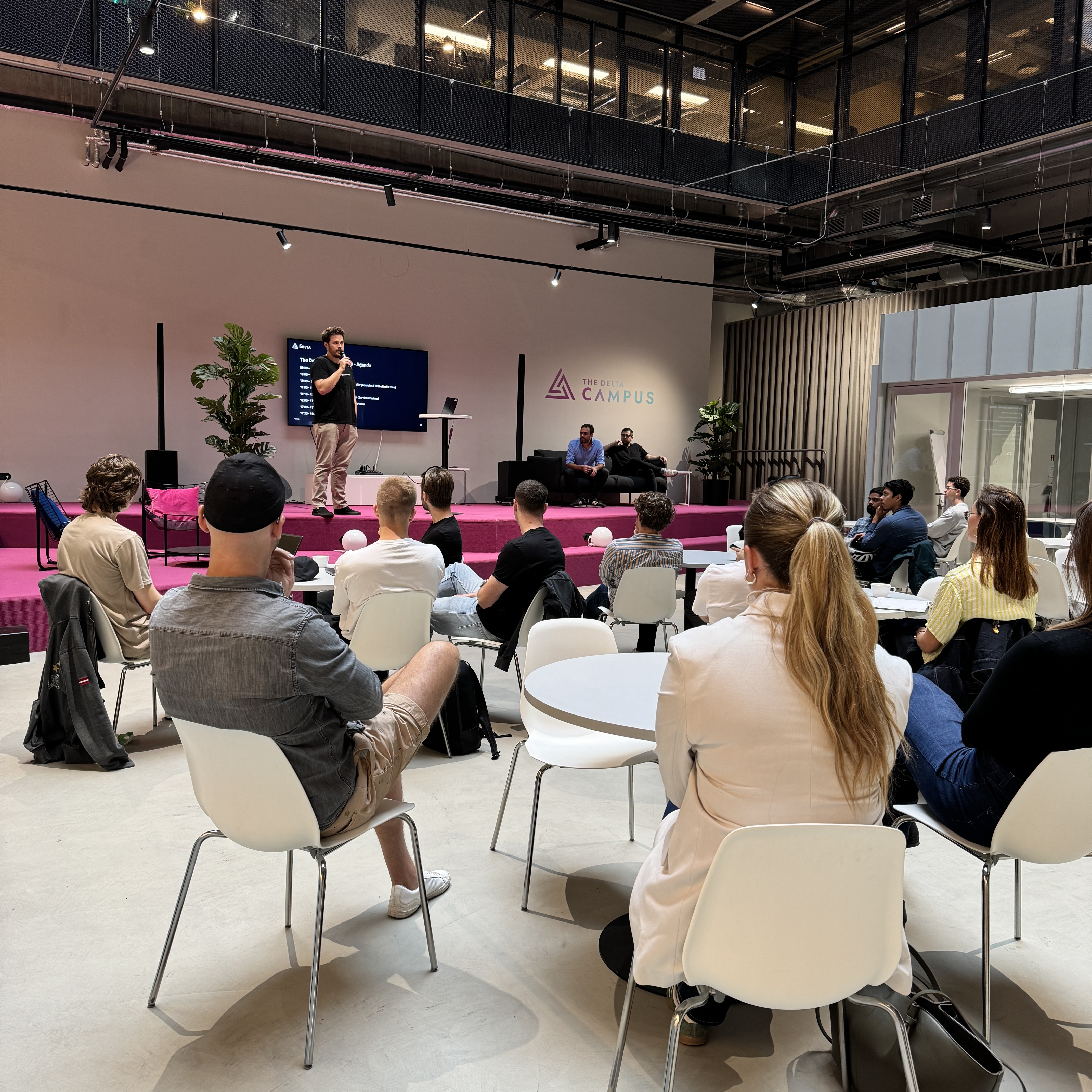
At the 9th edition of Gründerszene × The Delta, Nikita Fahrenholz joined Gründerszene's Leo Ginsburg on stage for a conversation that started with the kind of coincidence you can't script: hours earlier, Uber had announced it was acquiring Delivery Hero, the company Nikita helped found in his early twenties, for a reported $13 billion.
As co-founder of Lieferheld, the startup that laid the foundation for Delivery Hero, and later co-founder and CEO of the cleaning marketplace Book A Tiger, Nikita is one of Berlin's most recognizable serial entrepreneurs. But as he told the room, none of it started with a plan. It started with a 24-year-old who didn't know enough to be scared.
A childhood with no romantic version
Nikita grew up in Hellersdorf and Marzahn, in what he calls "the Platte," the prefab housing blocks of East Berlin, in a neighborhood he says used to have "the most modern apartments" of the era, back when having your own toilet in the flat was still a novelty in parts of the city. He was born just before the Wall came down, but he's quick to deflate any narrative that tries to connect his childhood directly to his entrepreneurial drive.
"I had this conversation once with someone who tried to impose that whole story onto me," he said. "For me, GDR was just a very short period of my life. I don't have this kind of romantic, melancholic view of a divided Berlin that you see in the movies. My entrepreneurship journey has nothing to do with that at all. I just went with it."
What he does credit from those years is something less poetic: a family that moved around a lot, and an early comfort with instability that never really left him.
Named after a few beers
Nikita didn't set out to build a food-delivery empire. He started by working with people he liked, supporting an early-stage startup, until someone he'd connected with said, "you should build something with me." That's how he ended up sitting in an apartment in Mon Bijou, in the middle of Berlin, trying to name a company that didn't exist yet.
The naming process was not glamorous. "There were so many stupid names, I can't even believe it," he said. Early candidates included Liefer Prinz and Liefer Hanks. The latter, he admits, sounded more like a Berlin nightclub than a delivery company. The name that stuck arrived the way plenty of founding decisions do: informally. "Then I just, along one evening with a lot of beers, at some point I came up with Lieferheld."
Buy, don't build
The turning point that took Lieferheld from a scrappy local startup to the foundation of Delivery Hero wasn't a single flash of insight. It was a deliberate strategy Nikita helped execute for years as the company's M&A lead: buy revenue instead of building it from scratch. "Be it Grubhub in the US or us in Germany, buying most of the revenue, not doing a green field. We bought into India, South Korea, Australia, South America. We bought Yemeksepeti in Turkey, one of the largest players globally."
The logic behind it, as he explains it now, is about unit economics that only really work with one dominant player in a market. "There's always this really big marketing war of platforms buying customers off each other, and switching costs keep getting higher. If you consolidate into one player, it works out really well in terms of unit economics." It's the same logic, he pointed out, that now explains why Uber wants the company at all.
The moment it stopped being a bet
Nikita says he didn't take the business seriously as a potentially huge company until roughly a year and a half in. "I remember asking my co-founder: could this actually be a big company? We were surprised. It was kind of a chance, and it was way more detached emotionally than people assume. There's no emotion in building a website that moves bits around so someone gets a pizza. You're not changing the world."
The real signal that it had become something serious came later, when Nikita found himself on the pre-IPO roadshow in New York, pitching institutional investors on a company he'd started in a shared apartment a few years earlier. "For me, it was over, in a good way, during that pre-IPO process. That's when the emotional detachment really set in."
The failure that still stings
Not every market bent to the buy-and-build playbook. China was the one Nikita couldn't crack, despite trying. "We had a company there. It's traveling to Shanghai quite often, back then, and it just wasn't possible to build anything serious, because within a year there were like 30 or 40 competitors, heavily funded. There's quite some subsidization going on in China. That was impossible for us to conquer." He puts India in a similar category today, not because of funding wars, but because of how specific and locally-rooted the culture of building business there is. Both markets, in his view, will likely stay outside the consolidation wave he expects almost everywhere else.
Uber calls it $13 billion
By the time Uber's acquisition of Delivery Hero made headlines, Nikita had already been financially and emotionally out of the story for years. He'd sold most of his shares earlier, at a share price two and a half times higher than what today's deal implies. "The takeover is now at around 13 billion. The highest point of the share price was 128 euros per share. I didn't exit everything at that price, I'd exited even before that."
His reaction to the news, delivered from the stage minutes after finding out, summed up fifteen years of distance from his first company: "I got a couple of congratulations on WhatsApp today, actually from Uber management as well, which was really funny. For me, it was quite nonexistent, to be honest. It was a news story for you guys. Not so exciting, I have to say. But obviously it's cool that it finds a home."
Founder Learnings
- Ignorance is a real asset at 24, but only once. Nikita is candid that not knowing the risks is what let him build fearlessly in his twenties. It's not advice you can manufacture later, only a window to use while it's open.
- Buy-and-build only works with a dominant end-state in mind. Delivery Hero's acquisitions across a dozen countries only made economic sense because the strategy was always consolidation toward a single winner, not just growth for its own sake.
- Some markets won't bend to your playbook, no matter how much capital you have. China's subsidized, hyper-funded competition beat Delivery Hero outright. Recognizing an unwinnable market early is its own kind of discipline.
- Emotional detachment from your own company isn't cynicism, it's protection. Nikita's distance from Delivery Hero, built up over years, let him watch a $13 billion headline about his own creation with genuine indifference instead of grief.
- The best origin stories are rarely strategic in the moment. A company name, a co-founder, a first idea: Lieferheld's foundational decisions were made with beers and instinct, not a masterplan.
If you are ready to start building, The Delta Campus is where that journey begins, so book your tour now or contact us.
Written by Alexandra Matthews
Chief Operating Officer