For the past few years, while building AI companies, I kept coming back to the same question. How do we stay regulated in a world that keeps getting more intense?
The pressure on our nervous systems is rising everywhere. News cycles, notifications and an always-on economy already ask more of our bodies than they were built to process. And the years ahead, with AI disrupting work on top of climate and conflict, will add intensity rather than take it away. More and more people are living in a near-permanent state of overwhelm. It’s not a disorder, but a nervous system asked to carry more than it can regulate.
I thought AI could be part of the solution. Working with it every day taught me the opposite.
The Attention Trap
Consumer technology makes its money with attention. Feeds, recommendation engines and now AI companions are built to hold you inside the product for as long as possible. Gloria Mark at UC Irvine has measured what this does to us. The average attention span on a screen has fallen from about two and a half minutes in 2004 to 47 seconds today.
An AI that is optimized for engagement will not meet you where you are. It agrees with you, flatters you and pulls you down self-reinforcing rabbit holes instead of actually supporting you. If you have ever tried to calm yourself down with a chatbot at 2am, you know what I mean.
The deeper problem is more fundamental. AI can simulate understanding and it can provide advice. But it cannot be another living human nervous system, and there is no way for it to replicate one. What a person needs in a moment of nervous system overwhelm does not happen on the rational level at all. It happens in the body. When your system is flooded, there is reduced cognitive bandwidth left, and another piece of advice is the last thing you can process.
What Actually Regulates Us
In recent years I have learned a lot from Thomas Hübl, whose work on collective trauma and relational presence has changed how I think about healing. The insight at the center of his teaching is simple. Nervous systems regulate through other nervous systems.
There is a strong scientific foundation underneath that idea. James Coan showed in fMRI experiments that holding a supportive person’s hand reduces the brain’s threat response. Social baseline theory, which grew out of that work, argues that closeness to other people is the brain’s default way of managing stress. Ed Tronick’s still-face experiments showed decades ago that babies learn to regulate themselves through their caregivers first. Stephen Porges has built an extensive body of work on how our physiology reads other people for signals of safety; some of its specific claims are still debated in the research community, but the broader understanding that our physiological state shapes how we feel, think and connect is widely shared. And Christina Bethell at Johns Hopkins, who contributed to the original research on adverse childhood experiences before pioneering the measurement of positive childhood experiences, has shown that positive relational experiences have large, measurable effects on lifelong health, building on findings that reach back to the Harvard Mastery of Stress Study in 1954. Relational health is not just a buffer against adversity. We need it even when nothing is wrong.
A dysregulated nervous system calms down next to a regulated one, the way a small child settles with a calm adult. Our species has always gotten through crisis this way.
I want to be precise about what this evidence shows. That humans regulate socially is well established. What no study has yet proven is that a few minutes of remote presence with a trained, initially unfamiliar human produces the same effect as holding your partner’s hand. That is the foundation we are building on, the belief we hold, and exactly the question Attuned is now setting out to prove: that the principles of co-regulation can be translated into remote, scalable human presence.
Everyone is talking about technological breakthroughs right now. What we barely notice is that we already have access to the most groundbreaking technology of all: co-regulation. It is ancient, it is built into every human body, and it has never been scaled.
If moments of dysregulation are going to increase, the answer is not more artificial intelligence. The answer is scaling this ancient technology: co-regulation between humans.
Our Thesis: Regulation Is Power
That is why Rebecca Godfrey, Thomas Hübl and I have started Attuned, with the vision to support the regulation of nervous systems at global scale. A collective rebalancing, at a moment when the world is running hotter than our bodies can follow.
Attuned is not a mental health app. We see it as the beginning of a new domain: regulation and relational health. Every mental health app assumes you are calm enough to open it, read it and follow instructions. Attuned starts where that stops working. For self-regulation, the app offers short haptic sessions that turn designed frequency patterns into vibration through the phone, plus guided audio sessions created with Thomas. Early research on vibrotactile stimulation and heart rate variability is promising, and whether our specific frequency system reliably shifts physiological state is something we are actively testing, with every session measured rather than assumed.
When regulating alone is not enough, you can connect with an Anchor, a vetted person trained in our peer-presence protocol, who is simply there with you for a few minutes. No conversation required. There are no streaks, scores or guilt mechanics anywhere in the product, and everything is private by design.
What Early Users Are Telling Us
Customers in our closed alpha are reporting great results. Retention on the self-regulation sessions is very high, and co-regulation is being used in ordinary, day-to-day situations: walking into a social setting with social anxiety, walking into a meeting with your boss while feeling very tense, or connecting to a regulated nervous system before sleep, with users reporting real ease in falling asleep.
But the greatest feedback we have received is simpler than any of that. Just knowing that your phone is in your pocket, and that you could connect to another human within a few seconds, already makes people move through their day in a different state of mind.
The Opportunity
The nearest reference market shows the scale of the need. Mental health apps are worth about $7.5 billion today and projected to reach $17.5 billion by 2030, inside a $125 billion US mental wellness market and a $6.8 trillion global wellness economy. The defining weakness of that category is retention. Roughly half of users churn within weeks, because a content library does not change your state. Attuned is built around exactly that weakness. Every session records how the body responded and personalizes the next one, so retention compounds where the category collapses. And a growing network of trained human Anchors is something no model can copy.
The Team
Bringing co-regulation to the world takes an unusual mix of lived experience, human development and technological scale.
Rebecca Godfrey, our Founder and CEO, spent more than a decade as a globally touring electronic music artist and product leader. Diagnosed autistic as an adult, she built Attuned as the product she needed in the moments when meditation apps were least usable. Thomas Hübl, author of “Healing Collective Trauma”, founder of the Academy of Inner Science and one of Watkins’ Spiritual 100 in 2026, brings more than two decades of work on trauma, presence and relational healing, including being a visiting scholar and mentor at, and collaborating with, the Wyss Institute at Harvard Medical School. Through The Delta, we are backing formation, network and scale.
I have started and backed many companies. I believe this is the most important project I will ever work on, and I am extremely passionate about bringing this product to the world.
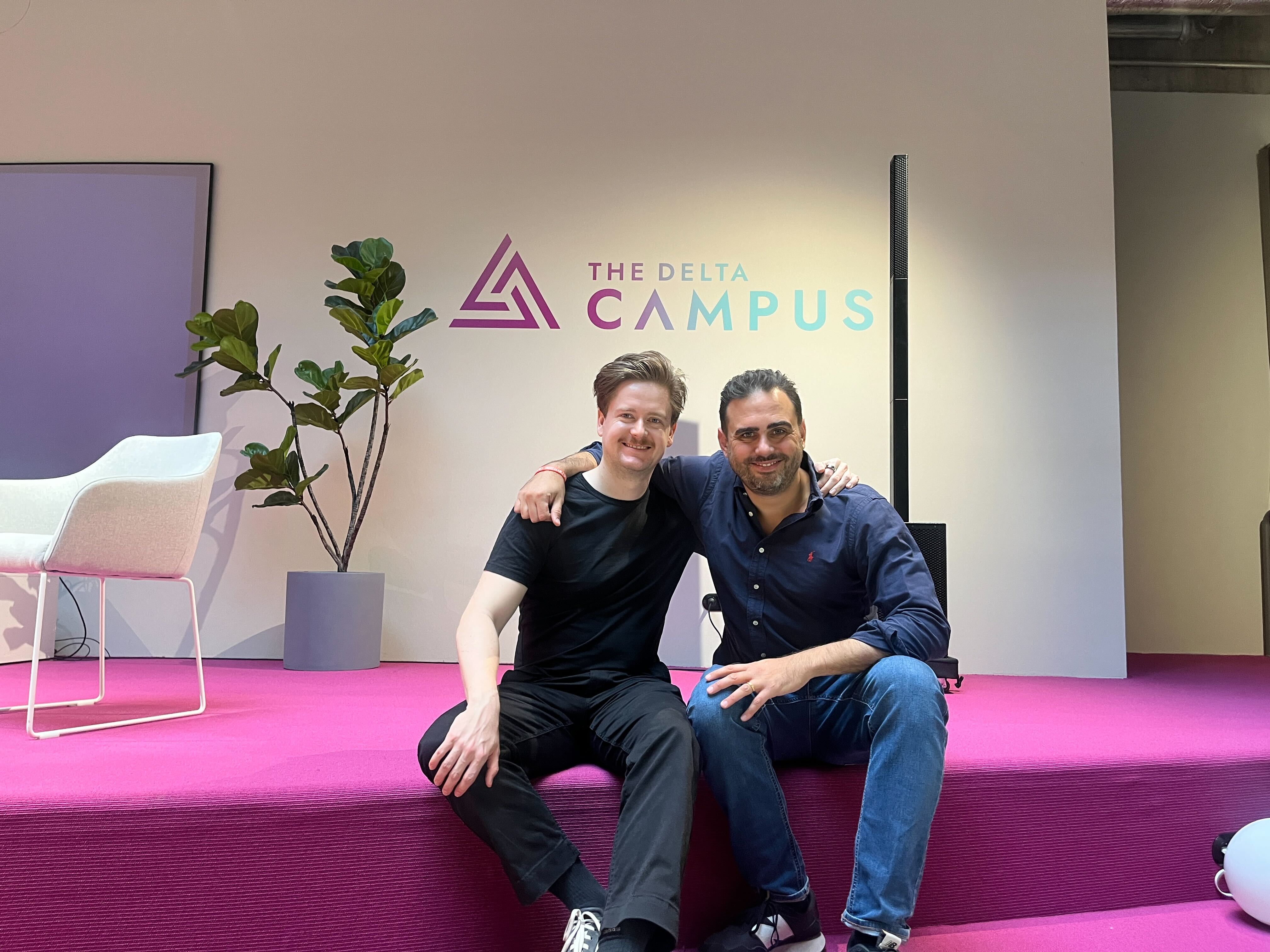
Attuned has a launch party on 25 August at The Delta Campus in Berlin. The public beta opens in September, and you can join the waitlist now at www.attuned.world.
Regulation is power. You have the right to remain human.
Welcome to Attuned.
Written by Julian Teicke
Chairman