
- Lennard Schmidt believes luck largely decides which category you start in and how big it can become, but good decisions still determine how far you get.
- Before Langdock existed, the three co-founders met at 8:30, six days a week, for months and worked through around 15 ideas until the market pointed them towards AI.
- Langdock pivoted during Y Combinator after CTOs kept saying they could not roll out ChatGPT to employees because of compliance, works council and security concerns.
- Merck became Langdock's first customer with more than 10,000 seats after spotting a launch video on LinkedIn, and the founders won it by deploying on Merck's own infrastructure and being open about where they stood, including on price.
- To keep their friendship and partnership healthy, the co-founders take a weekly walk and regular founders' trips so that emotional debt never has a chance to compound.
In this article
- Business is like chess, until the dice roll
- A late start in tech, and what an ice cream shop can't do
- A hospital bed, and a job at Jimdo
- Turning down WHU for a university nobody had heard of
- A safe place to grow up
- Neighbours, long walks, and emotional debt
- Advice for finding a co-founder
- 8:30, six days a week
- The pivot at Y Combinator
- Two syllables and a .com
- Three customers, three reasons, five months
- Founder Learnings
- FAQ
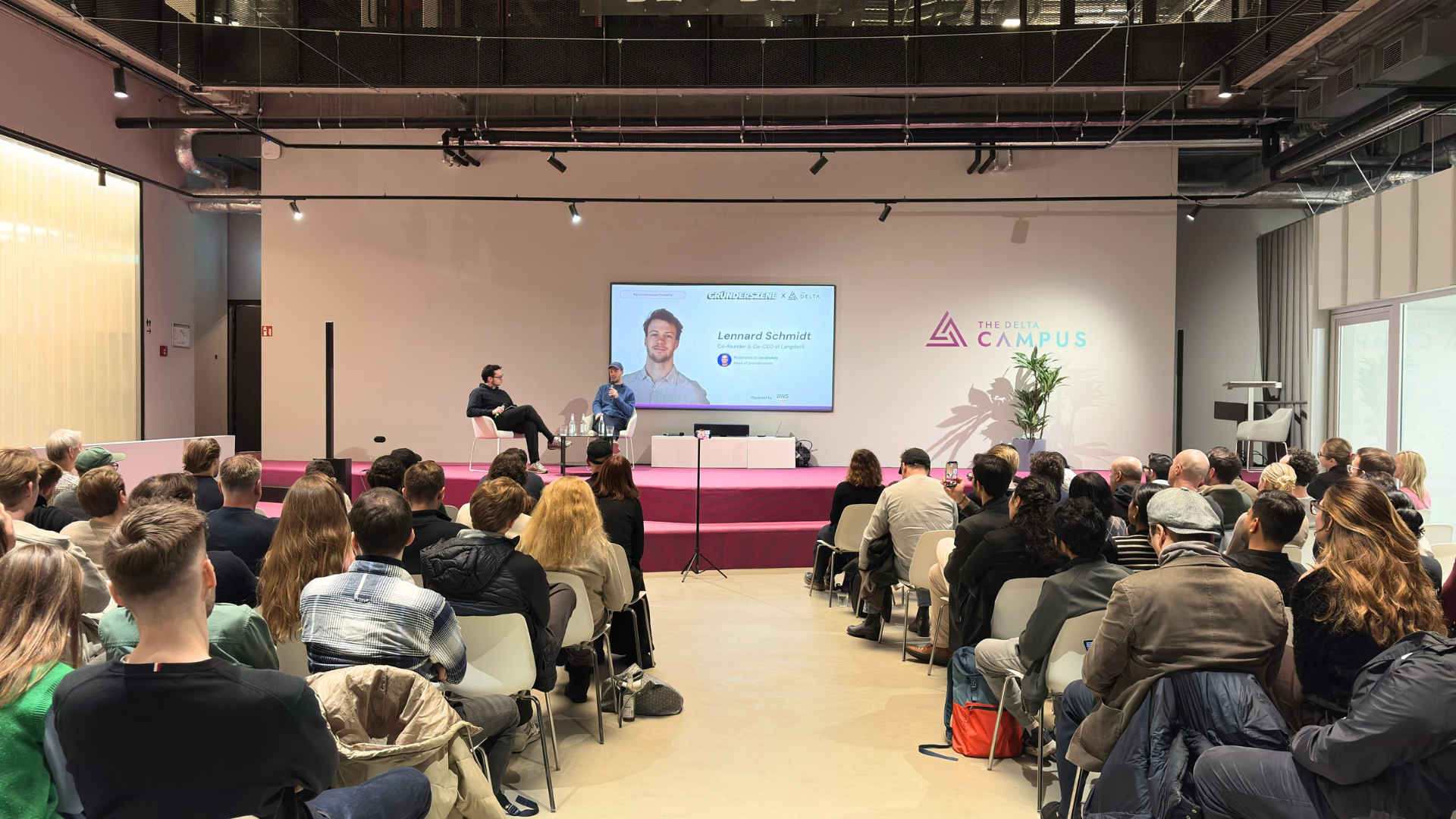
At the 12th edition of Gründerszene × The Delta, Lennard Schmidt sat down with Leo Ginsburg, Head of Gründerszene, in front of a full room of founders, operators, and investors. It turned into one of the most honest conversations we have had on this stage about luck, friendship, and what it really takes to get a company off the ground.
Lennard is co-founder and co-CEO of Langdock, the enterprise AI platform that gives organisations access to leading AI models in one GDPR-compliant workspace, with chat, agents, workflows, and integrations. Langdock counts companies like Merck, Trumpf, and GetYourGuide among its customers and reports €50 million in annual recurring revenue.
But Leo started somewhere unexpected: with the one and only tweet on Lennard's X profile.
Business is like chess, until the dice roll
The tweet, from October 2024, says something like: business is like chess, only after the dice have rolled do you know who has the better cards. Lennard insisted he was sober when he wrote it. It was a nod to an old Instagram page that made fun of consultants, investment bankers, and their lion-mindset quotes. He still barely uses the platform. "I also still call it Twitter."
The joke opened a real question, though: how much of Langdock's success is strategy, and how much is luck? Lennard thinks people tend to underestimate luck. "Both things can be true at the same time." In his view, luck largely decides which category you start in and how big it can become. After that, you still have to make good decisions to get the most out of the situation you find yourself in.
His own example: the founding team spent almost a year ideating, on everything from crypto infrastructure to software for golf clubs. Right in the middle of that process, ChatGPT launched.
A late start in tech, and what an ice cream shop can't do
Lennard grew up in Hamburg, had good friends, and played a lot of football. His parents come from civil engineering and law, and technology was not a big part of life at home. His interest only really matured at 16 to 18, once he had his own equipment. The real unlock was his first MacBook, a gift from his first employer, the Hamburg website builder Jimdo.
What hooked him was leverage. "I can sit on this stage, and there are still people using Langdock right now," he said, because the software simply runs on a server somewhere in Frankfurt. "That's something an ice cream shop can't do." Technology lets you delegate tasks to systems. You just have to come up with what they should do for you.
Can his parents explain what Langdock does? "Not fully." Langdock is about to test that with a Family Day, its own version of the German Elternabend, where the team brings parents and kids to the office and parents are put in front of a camera to explain what their children do all day. "They're very proud and they're very happy, and that's worth something."
A hospital bed, and a job at Jimdo
His family wanted him to work alongside school. At first he dodged it by becoming a football coach. Then an accident put him in hospital for months, and between that and time abroad, he was out of the German school system for about a year and a half. It gave him time to reflect. "I felt in that moment I could just do more with my life."
A nearby supermarket paid more per hour. But Lennard had used Jimdo to build a website for his school team and saw it was hiring working students. "I said, I'm not a working student, but I'm a working high school student. Can I apply?" They said yes, and he joined customer support, back then via live chat.
Nobody in his family had built a company. Jimdo was different. The founders walked around the office, which had expanded into a building that was never meant to expand, with new doors and walls added wherever they were needed. "You could just do things, and you were judged by what you could achieve and how you could help." That experience nudged him toward studying somewhere close to startups and technology.
Turning down WHU for a university nobody had heard of
His Abitur grade was a 2.0, one point away from a 1.9, which he joked still pains him. But he already had acceptance letters before graduating, partly because he always did many things on the side: a scholarship to study business alongside high school, his job, and coaching football, including his school's teams. "You can just do things. The more initiative you take, the more you'll expose yourself to things you may or may not like."
He was accepted to WHU, one of Germany's most prestigious business schools. He chose CODE University instead, which had just been founded, and joined its very first cohort. To him, it did not feel like a risk. CODE offered three things he wanted:
- It was in Berlin, which in 2016 and 2017 was by far the most relevant place in Germany to start a company.
- It had a new learning concept, with no classes or exams, only hands-on, project-based work.
- It was a direct entry point into Berlin's ecosystem of startups, scale-ups, and larger companies.
It did not hurt that WHU had rejected his best friend, a perfect 1.0 student and one of Germany's best debaters. His parents, on the other hand, first asked what on earth CODE even was. For Lennard, it came down to the story. "If I'm 80 and I have grandchildren, what are the cool stories I can tell them?" Being in the first year of a brand-new university was a much better one.
A safe place to grow up
CODE gave him the freedom to explore. He could choose his subjects, choose how to learn them, join a startup, found an agency, and still earn ECTS credits at a state-accredited university. He called it a secure environment for young people who still need to grow up. It is also where he met his co-founders, Tobias Kemkes and Jonas Beisswenger, and Judith Dada, now his co-CEO, who came to an event they organised and stayed in touch.
CODE is now part of The Delta Campus, and Lennard made a strong case for it. As a private university, it is financed largely by people who donated money to something that is not profitable. By his estimate, less than €50 million has gone into CODE over the last ten years, while the startups that came out of it are worth a few billion euros combined. "That's a strong business case, at least for Germany as an economy."
Neighbours, long walks, and emotional debt
Tobias was his neighbour. Of roughly 90 students in CODE's first year, about 20 lived in the same newly opened building. The two co-organised UNICON, a student conference they started in 2018, and worked on agency projects together. Jonas, also at CODE, was running his own agency in Frankfurt. They swapped notes on things like how to charge clients and became friends.
What made them click? "Vibes," Lennard said. They are very similar in some ways and very different in others, which makes them complementary. It comes from mutual respect, and from knowing what gives each of them energy and what drains it. Lennard is not the one who loves stages, but Tobias and Jonas hate it even more.
The harder part is keeping the relationship healthy as the company grows. Since they started ideating about four years ago, the three have gone on a one to three hour walk together every week, and every quarter or half year they take a founders' trip. The goal is to never let negative feelings compound. "For all the engineers in the room, there's technical debt. I think the same applies to emotional debt, or organisational debt." So they bring goodwill to every discussion and look for common ground early, before anything has the chance to explode.
Advice for finding a co-founder
Is founding with friends a good idea? Lennard was careful not to hand out a lottery ticket for everyone to copy. It depends on your context. For them, friendship adds a layer of trust and shared values that helps in a very disruptive time.
His first piece of advice applies to everyone: get as technical as you can. Yes, you can vibe code most things now, and even Langdock's engineers mostly review code rather than write it by hand. But understanding how software is built still shapes the mental models you need to make good decisions, even if you are the business co-founder.
His second: work on projects together before you commit. See how you work, what matters to each of you, what you can realistically give in time and skills, and what you are and are not fine with. The three of them even went through a founders' version of the famous questions to fall in love, to check they were aligned on what they were trying to achieve.
8:30, six days a week
The timing lined up. All three wanted to build a company, and all three were ready to leave what they were doing. They sat down and talked through what success meant to them and what each could bring. Then they made a commitment: from a set date, they would meet every day at 8:30, six days a week, and work on their ideas. They kept that up for months before Langdock existed.
They went through around 15 ideas. They looked at crypto infrastructure as proof of stake was going mainstream, and Lennard still believes in stablecoins. But nothing grabbed them the way AI did. "The market decides for you," he said. In ideation, you have very little of anything, except time. They used it to talk to as many people as possible and understand what was suddenly possible after ChatGPT.
The pivot at Y Combinator
They got into Y Combinator with a different idea: infrastructure for ChatGPT plugins. They quickly realised it would be very hard to make money with it, and agreed to pivot while still in the batch.
YC changed everything around them. "Before YC, we were essentially three unemployed people in Berlin. After YC, we were YC founders." People made intros, and within days the team kept hearing the same problem from CTOs: I use AI, I see the value, but I can't roll out ChatGPT to all my employees because of compliance, the works council, and security concerns.
The first solution was not even software, but a way to roll out AI using sub-processors within the EU. The underlying insight still drives everything Langdock builds: companies want control over how AI is rolled out. Which models employees use, where the data goes, which integrations are connected. Langdock became that control layer.
His biggest YC lesson: "Everybody cooks with water." He believes YC bet early that capital and advice would become commodities, while community and brand would only grow in value. With more than 5,000 companies, it has turned its learnings into a knowledge base, a community that shares openly, and partners who are mostly former founders themselves. And the brand opened doors to customers. "People were like, okay, if you're in YC, you have to be smart."
Two syllables and a .com
Lennard has two rules for a name: no more than two syllables, and the .com has to be available. He was buying a döner when he called Carl, now Langdock's VP of Engineering. "Lang" came from language models, with LangChain and Langfuse around at the time. "Dock" came from both of them being from Hamburg. Langdock.com was free, so they bought it, and that settled it. "We needed a name, and that was the most pragmatic solution."
Three customers, three reasons, five months
Langdock launched in the summer of 2023, and within five months it had signed three very different customers:
- The first customer with more than 10 seats was a Christian foundation in southern Germany. The team had posted in CODE's Slack about what they were launching. A student's father was the foundation's head of IT, an early AI believer facing exactly the problem Langdock solved.
- The first with 100 seats was HeyJobs, a Berlin scale-up. ChatGPT had no team licence at the time, and procurement did not want 200 separate invoices every month for private subscriptions.
- The first with more than 10,000 seats was Merck, the DAX company from Darmstadt, which signed in December. Merck had already built its own internal version and had product-market fit inside the company, but its team could not keep up with the features coming out of San Francisco. Langdock offered to deploy its software into Merck's own environment as a full stand-in.
How do three young founders reach Merck? They didn't, at least not actively. Someone close to the relevant team saw one of Langdock's launch videos on LinkedIn and made the connection. "It was them pulling it, not us pushing Langdock to them."
Asked in the Q&A how they closed a company like Merck without certifications, Lennard gave three reasons. Deploying on Merck's own infrastructure meant many compliance requirements did not apply yet. Merck had already convinced itself that the problem was worth solving. And the team was extremely responsive and transparent. When it came to pricing, they told Merck exactly where they stood: "We're no ones. What's a price that's a no-brainer for you?" They took that price, which made complete sense for them too.
To this day, one of the co-founders still has a weekly one-hour meeting with Merck as a design customer. Because Merck was so early, what it wanted two years ago is what other enterprises want now. "We're not a frontier lab," Lennard said, "but we're a frontier settings company."
Founder Learnings
- Respect luck, then earn it. Luck often decides where you start, but your decisions decide how far you get.
- Choose environments where you can just do things. Jimdo and CODE both rewarded initiative over credentials.
- Pay down emotional debt early. Weekly walks and founder trips keep small frustrations from compounding.
- Get as technical as you can, whatever your role. Understanding software shapes the decisions you make.
- Commit to a rhythm before you have the idea. Meeting at 8:30, six days a week, gave the team the time to find the right problem.
- Let the market pull you. Langdock's real idea came from listening to CTOs after a pivot during YC.
- Be honest about who you are. Transparency on where they stood, and on price, helped three young founders win Merck.
If you are ready to start building, The Delta Campus is where that journey begins, so book your tour now or contact us.