
- AI coding tools such as Claude Code can now write microcontroller firmware, set up peripherals, read datasheets with you and flag obvious schematic and layout mistakes.
- Software developers can get to a first working hardware prototype in a weekend, without years of background, a big team or a big budget, though they still need to check the output and understand how their code behaves in the real world.
- For experienced hardware builders, cheaper and faster revisions mean more attempts, quicker progress towards readiness level 7 and something real to show investors before the money runs out.
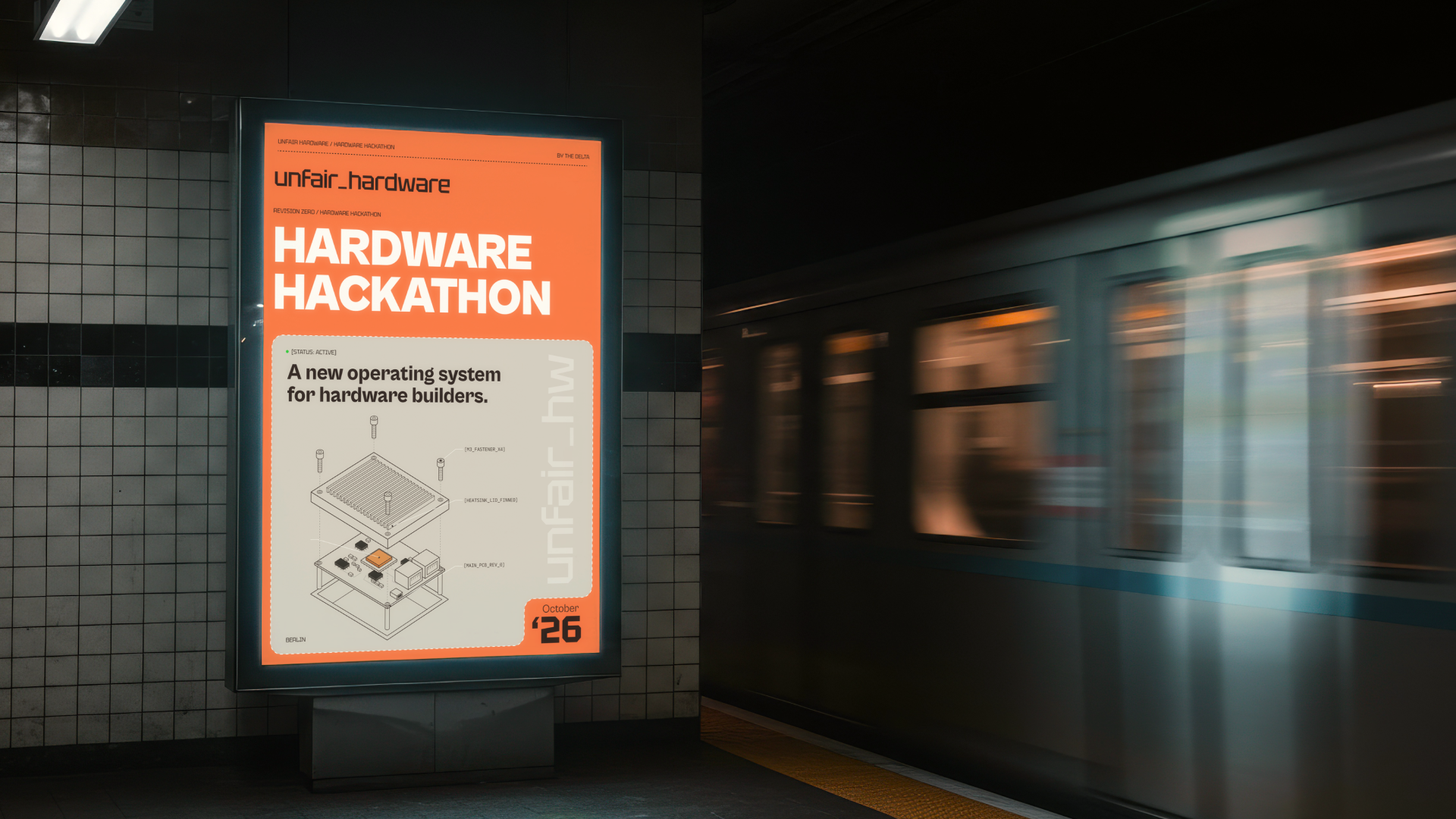
- unfair_hardware is a new Berlin launchpad for people using AI to build hardware at software speed, running themed Build Nights, Masterclass nights and Reverse Pitch Nights.
- The first Build Night is about Claude and hardware, and it is open to curious software developers and seasoned hardware builders alike.
Software developers are walking into hardware
Today we're launching unfair_hardware, a new Berlin community for people using AI to build hardware at software speed.
Here's why. Over the past few years, AI has changed how software gets built. A single developer can now ship in a weekend what used to take a team a quarter. We've watched that happen up close at The Delta, with founders on our campus building faster and with smaller teams than ever.
Hardware is next, and it's already starting. The same tools that write code can now write firmware, read datasheets and check circuit designs. That opens hardware up to a much bigger group of people: software developers who always wanted to build something physical, early-stage builders stuck between a prototype and production, and experienced engineers whose slowest step just got a lot faster.
What's missing is a place where those people meet. Newcomers need people who've shipped hardware before. Experienced builders want to see what the new tools can really do. And the companies building those tools need to be in the room where hardware is being made. So we're building that place, here in Berlin.
To see why now, look at what happened late last year.
A startup called Quilter set out to see how far AI could take a hardware project. Its team used its own AI tools to design a Linux computer: 843 components across two circuit boards, designed and assembled in a week. When they powered it on, it booted Debian on the first attempt, with only 38.5 hours of human work. Professional designers had estimated 428 hours of manual effort for an equivalent system.
Anyone who has built a board knows why that matters. By Quilter's own research, only about one in ten first board revisions works correctly. Hardware has always been slow because every mistake costs weeks.
That's starting to change.
The barrier used to be knowledge
If you were in software and wanted to build a physical device, you had to read schematics, pick parts, and write firmware for a chip you'd never touched. Raspberry Pi and Arduino opened the door, but there was still a steep learning curve, and a hard wall between tinkering on your desk and something working in the field.
Now you can sit next to a model that reads the datasheet with you. Tools like Claude Code can write firmware for a microcontroller, set up the peripherals, explain what a register does, help with a schematic, flag the obvious layout mistakes, and write the test code that shows whether your board works.
Anthropic tested this directly. In an experiment called Project Fetch, eight Anthropic researchers, none of them robotics experts, were split into two teams and asked to program a robot dog to fetch a beach ball. Only one team could use Claude, and that team completed more tasks and finished them faster. The biggest gap was in connecting to the robot and its sensors. There were several ways to do it, and the information online varied in accuracy. That's exactly the part that stops most software people from starting.
In a follow-up this June, Anthropic let Claude try on its own. Working without human help, Claude Opus 4.7 was about 20 times faster than the fastest human team, and it wrote almost ten times less code than the team that had used Claude. It wasn't perfect. Claude still struggled to move the ball precisely, which was the actual "fetch". You still need to know what you're doing, check the output, and understand what happens when your code meets the real world. But you no longer need years of background just to get started.
The money has noticed
Investors are betting that hardware design is about to change the way software development did. Flux announced $37 million in new funding, including a $27 million Series B led by 8VC. Quilter raised a $25 million Series B led by Index Ventures. Diode Computers raised an $11.4 million Series A led by Andreessen Horowitz, with Y Combinator participating.
Europe is in this too. Munich-based Celus raised a Series A to automate circuit board design from first idea through to the finished PCB, London's Circuit Mind puts AI agents to work checking circuit board schematics, and siliXon, founded by University of Cambridge engineers, is building AI that turns plain-language prompts into complete board designs, from schematics and parts to layout, with a seed round led by German investor System.One.
The direction of travel is clear. Flux describes itself as an AI hardware engineer for anyone, whether or not they have an electrical engineering background, and more than a million people have used it to design nearly 6.5 million devices, from wearables to drones to smart home controllers.
What changes for newcomers
The old barrier was knowledge you couldn't get without a degree or a lot of free evenings. Now you can ask a question at 11pm and get a useful answer. A first working prototype can take a weekend. Web developers, data engineers and tinkerers who never saw hardware as their thing are dipping their toes in, and loving it.
Someone with a good idea, a laptop and a board can get to a working prototype without a big team or a big budget. More people trying means more ideas get tested, and some of them will be really good.
What changes for experienced builders
What makes hardware hard is how many attempts you can afford. Every revision used to mean waiting on parts, redoing the layout and rewriting firmware. AI cuts a lot of that. Firmware changes take minutes. Design checks happen before you order a board, not after. When each attempt is cheaper and faster, you make more of them, and each one teaches you something.
If you've built boards for years, you get to a working prototype sooner and reach technology readiness level 7 much faster than before. A shorter loop from idea to working in the field gets you in front of investors with something real, because you find out what works before you've spent everything.
What we're running
unfair_hardware brings newcomers, experienced engineers and AI partners together around three formats:
- Build Nights, each with a specific theme and pitched at different experience levels.
- Masterclass nights, where an expert shares what they've learned with the community.
- Reverse Pitch Nights, where companies put real challenges in front of builders.
Berlin already has the builders. The city has its own off-grid mesh networking community, built on open-source LoRa radio projects like Meshtastic, with IRL meetups, chat rooms hosted at c-base, and a shared code repository. Just outside the city, in Am Mellensee in Brandenburg, volunteers had connected all nine districts through a municipal emergency mesh network by September 2025. Add AI to that kind of energy, and the loop gets very short.
The first Build Night: Intro to Claude and Hardware
For our first night, you'll pair with Claude to program a real board, connect it to every other board in the room in a network that works with no internet, and then take it outside for a range test. You'll go home with the board.
If you write software and you've been curious about hardware, now's the time to start. If you've been building for years, come and show us what a faster loop looks like.