
- Langdock raised $3 million in its seed round, never used more than half of it, and hired its sixth person only after passing half a million in revenue.
- More than 90% of Langdock's sales pipeline comes from brand awareness built on LinkedIn, the same motion that brought Merck to the company in its first year.
- Lennard Schmidt tracks NPS from users and buyers, unit economics and a monthly anonymous employee survey alongside revenue, and the team has grown from around 25 to about 70 people without a single resignation.
- Langdock plans to serve open-weight models on its own inference, giving customers more value per euro and partly hedging its exposure to token costs.
- Schmidt treats the company as if the market could change tomorrow, but protects his sleep, exercise and days off because tired founders make worse decisions.
In this article
- Ambition grows with the company
- Big sails are useless without wind
- The numbers that matter
- Calm urgency, ambitious execution, caring ownership
- Raising $3 million and spending less than half
- Founders of their own functions
- Paranoid, and well rested
- Why the office still matters
- What makes software defensible now
- Cheap tokens, and a partial hedge
- Incorporate when you need to, invest in friends
- The commitment that stayed with the room
- Founder Learnings
- FAQ
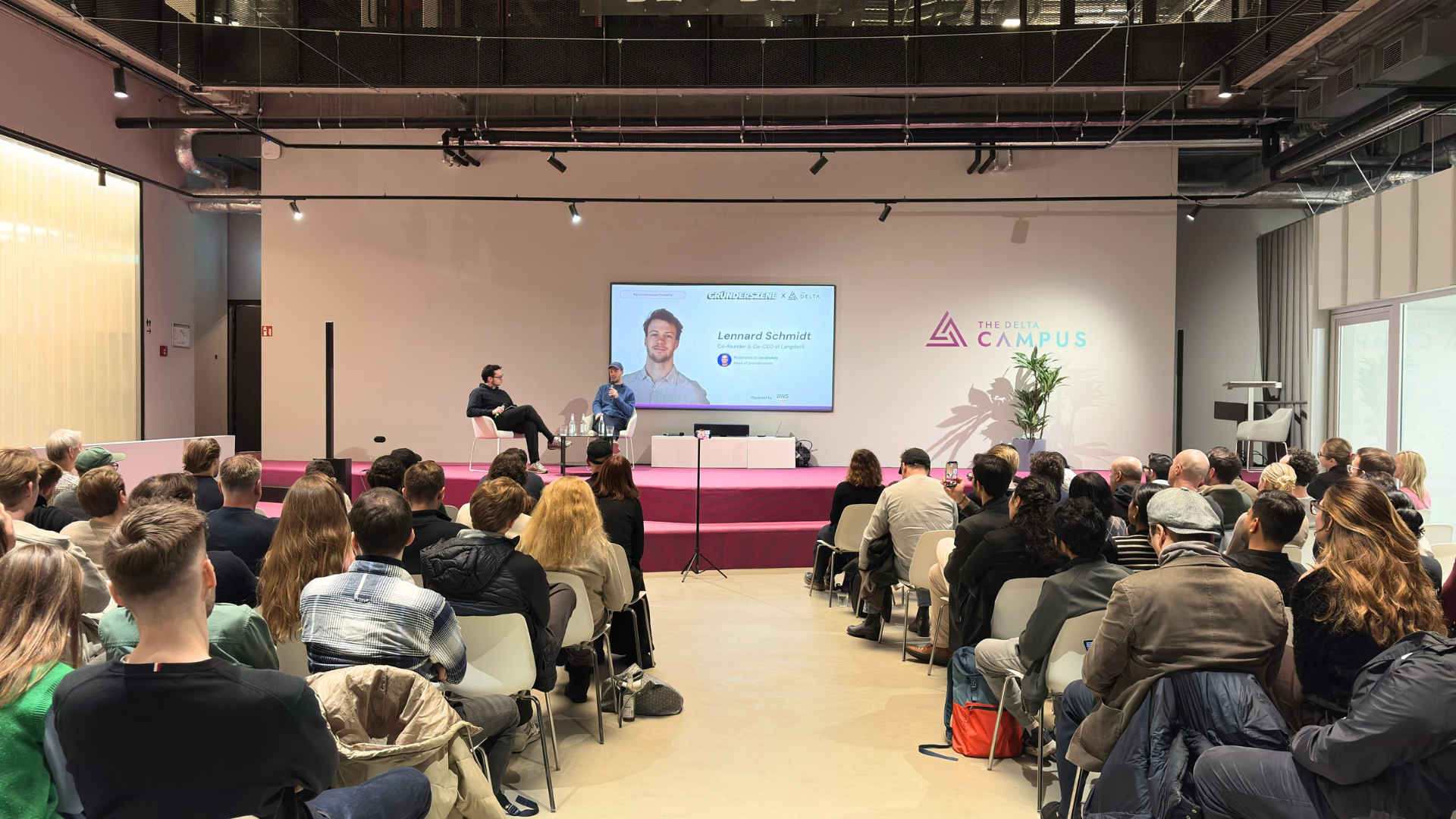
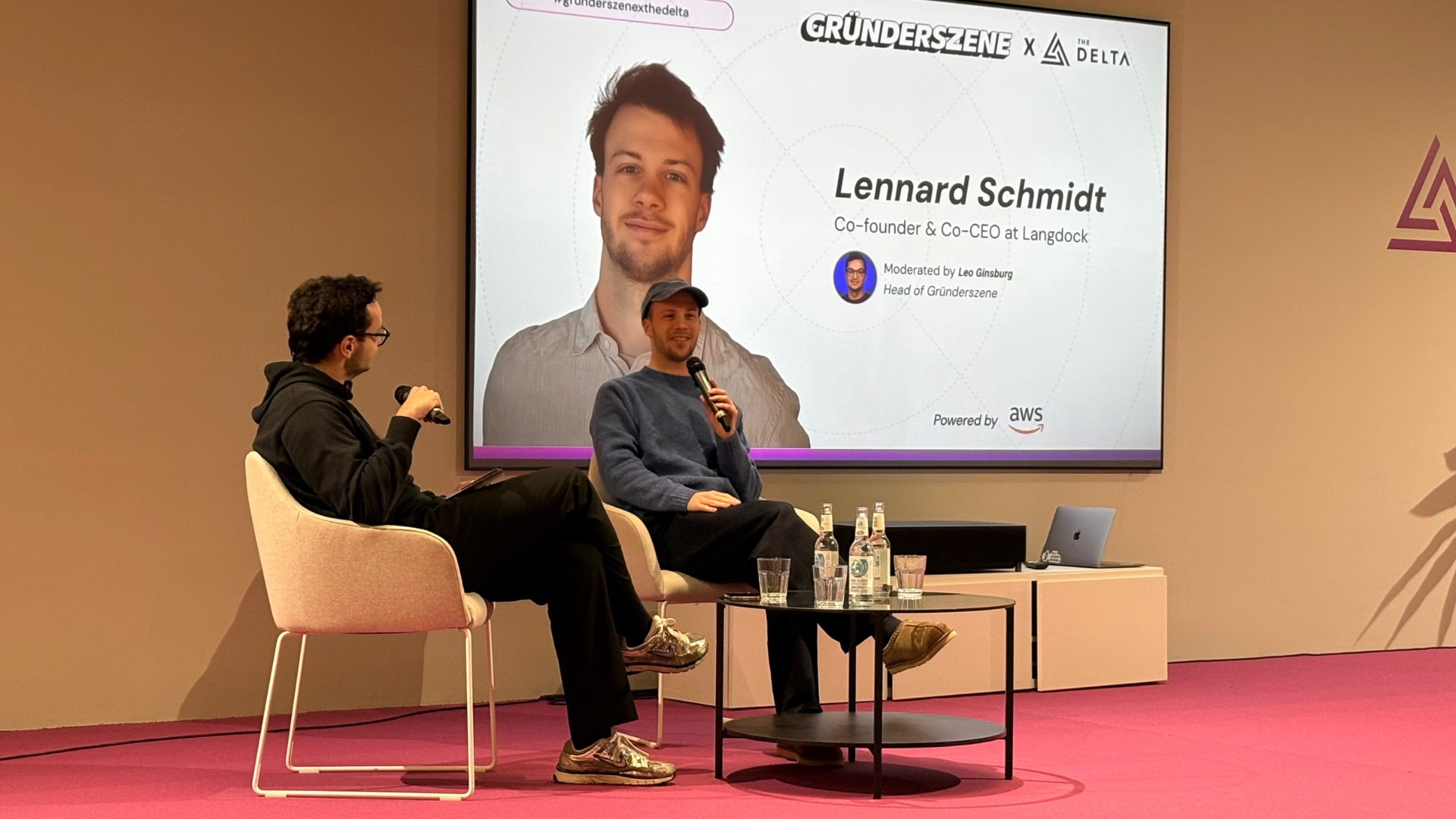
At the 12th edition of Gründerszene × The Delta, Lennard Schmidt did not just talk about how Langdock got started. In conversation with Leo Ginsburg, Head of Gründerszene, and in a packed Q&A with the audience, he opened up about how the company runs today: why it raised so little money, how it hires, why the team is in the office every day, and where Langdock is heading next, all the way down to its own inference.
Langdock gives organisations access to leading AI models in one GDPR-compliant workspace and reports €50 million in annual recurring revenue. Yet Lennard still talks about it like a company that could disappear tomorrow.
This is a story about building with ambition and paranoia at the same time, and why the most important stakeholders are still your customers and your team.
Ambition grows with the company
At the start, the founders' goals were modest. They liked building, they liked working together and independently, and they hoped it would lead to a good life. "We weren't talking like, we want to be insanely rich."
Then the company kept growing, and so did the ambition. Langdock started with chat, then added agents, integrations, and workflows, until it had become a platform with all of these form factors built in. Customers liked working with them and wanted more. So the next question was obvious: if Langdock already aggregates so much of its customers' AI demand and token usage, why not also supply cheaper tokens, and even build its own small data centre?
"We realised that we're extremely lucky and fortunate to be in the position we are in right now," he said. "And we want to cherish that by being more bold, by being more ambitious."
Big sails are useless without wind
How does a young startup sell AI to large enterprises while competing with companies like Microsoft? Lennard's answer was that brute force is extremely hard and expensive. What matters is developing an intuition for pull.
He compared it to sailing. "You can have the biggest sail, but if it's not in the wind, you're screwed." A startup starts with the smallest sail possible, because it has no resources. So the job is to position the founding team and the early product where the wind is, even if that means dropping the product and doing something else.
For Langdock, that wind still comes mainly from LinkedIn. More than 90% of the sales pipeline comes from the brand awareness its posts create, including its regular posts sharing ARR milestones, which tend to get a lot of impressions. The team has stepped up content and events, but the motion is the same one that brought Merck to them in year one.
The numbers that matter
Asked which number he looks at first every morning, Lennard said it is never just one. He watches NPS, both from end users and from the admins and buyers Langdock sells to, though the team only introduced it once there was enough data to act on. He watches revenue and revenue growth, but also unit economics. Because Langdock is so exposed to token costs, a priority has been building a product whose value is not too tightly tied to token consumption.
From early on, the goal was to be cash-flow positive and profitable, with a model that could scale. Lennard pointed out that many of the largest technology companies in the world, like Microsoft, Google, and Amazon, raised relatively little outside money before going public. "If you're able to do that, you'll gain a lot of control over your own destiny."
He is just as focused on the team. Langdock runs a monthly team survey and has tracked an internal employee NPS since it was about 20 people, with 15 anonymous questions built around its core values.
Calm urgency, ambitious execution, caring ownership
Those values are:
- Calm urgency. Topics need urgency, but without calm, everything becomes urgent. You need the intuition to pick the few things that matter most right now.
- Ambitious execution. Ambition has to keep growing, but "without execution to back it up, ambition is kind of worthless."
- Caring ownership. Caring for users, customers, and the team, and owning your projects.
What ties them together is adaptability. "Our company is changing shape every three to six months," Lennard said. The team has to keep refounding itself and reconfiguring how it works, often enough to keep up with the market.
Raising $3 million and spending less than half
Langdock raised $3 million in its seed round. It never used more than half of it. The founders raised it with a team of five, and only hired the sixth person once Langdock had passed half a million in revenue. "In hindsight, we could have just gone to the local Sparkasse and taken out a loan," he joked. But you never know the outcome in advance, and they did not want to spend their time fundraising, so they deliberately raised more than they needed to buy freedom.
Lennard is not dogmatic about it. There are still scenarios where raising makes sense, if the money can be deployed usefully. "We're not hardcore maxers of you should only bootstrap or only do VC. It really depends on your context." What raising so little did give them was focus. With investors who stay out of the way, they could concentrate on the two stakeholders that matter most: customers and the team.
Founders of their own functions
Lennard's role has changed constantly. Jonas still does what he has always done best: spotting what is worth building and turning it into a first live product incredibly quickly. He has no direct reports and no title, and most recently worked with a tiny team on Langdock's upcoming code product. Tobias has gradually handed over sales and then customer success to focus fully on product. Lennard now leads the commercial, business, and finance side together with Judith Dada, his co-CEO, and works increasingly project-based, focusing on what the company needs to get right in the next three to six months.
That only works if the team takes real ownership. Langdock has a strong share programme, but more importantly it hires for its core values. It is also growing deliberately slowly by AI standards, from around 25 people a year ago to about 70 today. Not a single person has resigned.
Getting the early hires right was critical. Carl and Niklas, the founding engineers, had been best friends and flatmates who Lennard knew from earlier projects and his agency. The next key business operations hire was someone he had already worked with at two other companies. Having known them for close to ten years set an extremely high hiring bar and a culture of trust from day one.
Asked in the Q&A how he works with people smarter than him, Lennard said he tries to be Teflon. When a problem comes up, he figures out who should own it, helps with analysis, and steps in only when it is useful. "Even under the assumption that I would be the smartest person in the company, which I think if you do that, you build a bad company, there's so much flying at you every day that you won't be good at dealing with everything." What he saves for himself is the co-founder card, used where it carries the most weight, especially with customers.
Paranoid, and well rested
Has he ever thought Langdock could fail? "Obviously." In his mind, Langdock is worth zero until something actually flows out of it. The longer you survive with a business model that works and does not burn money, the lower the risk becomes, but it never reaches zero. "We're still living under the assumption that this whole market is fugazi. We need to reinvent ourselves." That means not doubling down on today's products, and continuously building new ones to stay relevant.
But paranoia does not mean burnout. "I think you can be paranoid and you can still have a good life." Lennard averages 7 hours and 45 minutes of sleep a year, because he knows that when he sleeps too little for too many days, he makes worse decisions for the company. He averages over 10,000 steps a day, runs, often with people from the team, and tries to take at least one full day off each week. On vacation, he switches to a second phone that only his co-founders and his mum have the number for.
The team works hard, he was clear about that, including weekends. But Langdock does not believe in hustle for its own sake. He is a night owl, and if he works until 3 a.m., he will not be in the office before 10 or 11, and the team is expected to do the same. "We believe in working hard. We also believe in a useful balance that is necessary to take your decisions and do this for the long term."
Why the office still matters
One audience member, in her thirties and with a partner and a dog, had considered applying to Langdock but hesitated at its in-office culture. How would that work as the company grows to 100 or 200 people?
Lennard's answer was honest. First, Langdock tries to be as upfront as possible about how it operates, so people can decide for themselves. Second, the rate of change the company has to absorb is so high that losing the context and trust built through proximity would be a major downside. "Five days in the office at Langdock can feel like five weeks," he said. After a week on vacation, it takes him a full day just to catch up. When the company has to make breaking changes, it needs people in one room. He also admitted the answer may change as the company does.
The same applies to the founders themselves. "We humans are wired this way. We all came from caves with a bunch of people around us." If a colleague with a very direct style sends him a Slack message after two weeks apart, he reacts differently than if that person were sitting next to him. Accepting that, he said, is why the founders' answer to friction is still long walks through Berlin's parks.
What makes software defensible now
One founder asked the question on everyone's mind: if software is getting easier to build, and Langdock sits so close to the model providers, how does it stay defensible?
Lennard pushed back on the extremes. The idea that nobody needs to code anymore and software is finished ignores how complex the world is. There has been a correction in how software is priced, because the build-versus-buy calculation has changed. But software still needs maintaining, and as he pointed out, even OpenAI and Anthropic still run on tools like Workday and Salesforce.
He sees Langdock as a translator between model capabilities and economic value for companies. That gap keeps growing: models get faster and cheaper at astonishing rates, while organisations can only absorb a fraction of what is possible. "Innovation may still be tech-driven, but change is people-driven." So Langdock takes a human-centred approach, building software, systems, and a brand for the people who still make the decisions and drive the change.
In practice, that makes Langdock something like an index bet on AI adoption. It started with chat, then moved into agents, integrations, skills, coding, and infrastructure like sandboxes. And he does not believe the market will be dominated by one or two labs. A power user working alone has very different needs from an organisation of 100,000 people with many stakeholders.
Cheap tokens, and a partial hedge
Another question was about the cheap tokens and data centres he had hinted at. About a year ago, Lennard said, the launch of Claude Opus 4.5 and 4.6 kicked off the agentic era, and token spend went through the roof. Back then, frontier models were the only ones good enough for real work, and cheap enough to use for everything.
Today, frontier models are far more capable, but also much more expensive per task. Meanwhile, open-weight models have become good enough for most knowledge work. That opens up a gap Langdock wants to fill: serving open-weight models on its own inference so customers get more value for every euro they spend on AI. With so much token throughput across its own products, Langdock can now go a layer deeper into GPUs, infrastructure, and models.
It is also a partial hedge. "If tokens are cheap, it's really easy for us to create value for customers. If tokens are expensive, we're quite exposed." Producing its own cheap tokens lets Langdock either keep serving its products cheaply or sell tokens to customers at market rates.
Incorporate when you need to, invest in friends
Two practical questions from the audience rounded off the evening. When did they incorporate? Only when they were accepted into Y Combinator, around nine to ten months after they started working together, because YC required it to invest. Until then, they worked without their own legal entity. Without YC, they would likely have waited until they had revenue agreed with customers.
And on angel investing, Lennard keeps it small: a few thousand euros per ticket, only into people he knows. "To me, it's a paid newsletter on what my friends are up to." For most people, he thinks angel investing is a bad idea. "ETFs tend to work well."
The commitment that stayed with the room
In his closing remarks, Leo picked out the moment that stuck with him most. Not the revenue or the customers, but the commitment between the three founders, and the discipline of saying: we meet at 8:30, and then actually doing it for months, until they felt the pull of the market and knew they were onto something.
It is a fitting summary of how Lennard thinks about building. Stay humble about luck, stay paranoid about the market, and look after the people who make it possible.
Founder Learnings
- Put your sail in the wind. Brute force is expensive; position your team and product where demand is already pulling.
- Raise for freedom, not for status. Langdock raised $3 million, used less than half, and kept its focus on customers and team.
- Measure what you care about. NPS from users and buyers, unit economics, and an internal employee NPS all sit next to revenue.
- Hire people who will be founders of their own function. Then let go, and save your co-founder time for where it counts most.
- Stay paranoid, but sleep. Treat the market as if it could change tomorrow, and protect the habits that keep your decisions sharp.
- Be upfront about how you work. Let candidates decide for themselves whether your culture fits their life.
- Change is people-driven. As models get better, the value is in helping humans and organisations actually adopt them.
If you want to build something that lasts and do it alongside people who are thinking the same way, The Delta Campus is where that starts, so book your tour now or contact us.